PDF · English
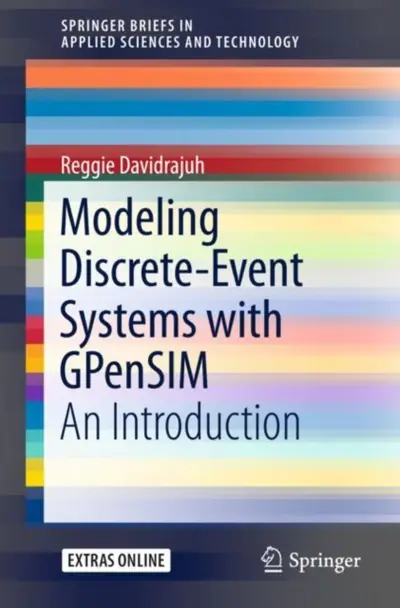
Modeling Discrete-Event Systems with GPenSIM
An Introduction
Price and availability
$67.99
Available in: Andorra, Austria, Australia, Belgium, Bulgaria, Canada, Switzerland, Cyprus, Czechia, Germany, Denmark, Estonia, Spain, Finland, France, United Kingdom, Guernsey, Greece, Croatia, Hungary, Ireland, Isle of Man, Iceland, Italy, Jersey, Japan, Liechtenstein, Lithuania, Luxembourg, Latvia, Monaco, Malta, Netherlands, Norway, Poland, Portugal, Romania, Sweden, Slovenia, Slovakia, San Marino, United States, Vatican City, South Africa
Stores: US, UK, Canada, EU, Australia.
Sign in to buyThe price is re-checked by the server before payment.
For personal use under the eBook licence.
- Format
- DRM
- Not stated by the publisher
- Language
- English
- Publisher
- Springer International Publishing
- Published
- 28 February 2018
- ISBN
- 9783319731025
- Subjects
- Business & management, Engineering: general, Electrical engineering, Computer science, Computer modelling & simulation, Management and management techniques, Engineering: general, Automatic control engineering, Computer modelling and simulation
About this book
Modeling Discrete-Event Systems with GPenSIM describes the design and applications of General Purpose Petri Net Simulator (GPenSIM), which is a software tool for modeling, simulation, and performance analysis of discrete-event systems. The brief explains the principles of modelling discrete-event systems, as well as the design and applications of GPenSIM. It is based on the author's lectures that were given on "e;modeling, simulation, and performance analysis of discrete event systems"e;. The brief uses GPenSIM to enable the efficient modeling of complex and large-scale discrete-event systems. GPenSIM, which is based on MATLAB(R), is designed to allow easy integration of Petri net models with a vast number of toolboxes that are available on the MATLAB(R). The book offers an approach for developing models that can interact with the external environment; this will help readers to solve problems in industrial diverse fields. These problems include:airport capacity evaluation for aviation authorities;finding bottlenecks in supply chains;scheduling drilling operations in the oil and gas industry; andoptimal scheduling of jobs in grid computing. This brief is of interest to researchers working on the modeling, simulation and performance evaluation of discrete-event systems, as it shows them the design and applications of an efficient modeling package. Since the book also explains the basic principles of modeling discrete-event systems in a step-by-step manner, it is also of interest to final-year undergraduate and postgraduate students.
Bibliographic data © Gardners Books Ltd.