PDF · English
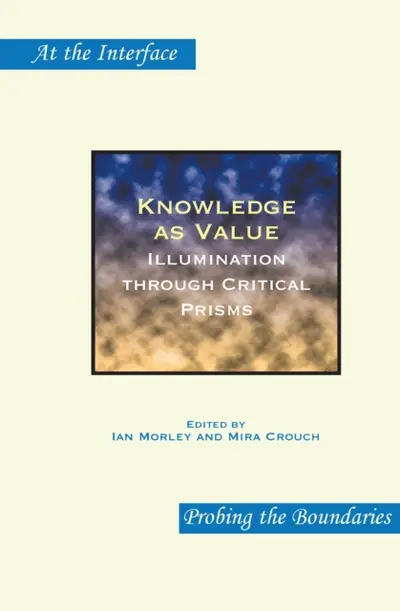
Knowledge as Value
Illumination through Critical Prisms
Price and availability
$131.99
Available in: Andorra, Austria, Australia, Belgium, Bulgaria, Canada, Switzerland, Cyprus, Czechia, Germany, Denmark, Estonia, Spain, Finland, France, United Kingdom, Guernsey, Greece, Croatia, Hungary, Ireland, Isle of Man, Iceland, Italy, Jersey, Japan, Liechtenstein, Lithuania, Luxembourg, Latvia, Monaco, Malta, Netherlands, Norway, Poland, Portugal, Romania, Sweden, Slovenia, Slovakia, San Marino, United States, Vatican City, South Africa
Stores: US, UK, Canada, EU, Australia.
Sign in to buyThe price is re-checked by the server before payment.
For personal use under the eBook licence.
- Format
- DRM
- Not stated by the publisher
- Language
- English
- Publisher
- Brill
- Published
- 1 January 2008
- ISBN
- 9789401206143
- Subjects
- History, Social & cultural history, Philosophy, Philosophy: epistemology & theory of knowledge, Ethics & moral philosophy, Society & culture: general, Popular culture, Sociology, Education, Politics & government, Interdisciplinary studies, Cultural studies, Education / Educational sciences / Pedagogy, Philosophy: epistemology and theory of knowledge, Ethics and moral philosophy
About this book
This book considers the place and value of knowledge in contemporary society. "e;Knowledge"e; is not a self-evident concept: both its denotations and connotations are historically situated. Since the Enlightenment, knowledge has been a matter of discovery through effort, and "e;knowledge for its own sake"e; a taken-for-granted ideal underwriting progressive education as a process which not only taught "e;for"e; and "e;about"e; something, but also ennobled the soul. While this ideal has not been explicitly rejected, in recent decades there has been a tacit move away from a strong emphasis on its centrality, even in Higher Education. The authors address the values that inform knowledge production in its present forms, and seek to identify social and cultural factors that support these values.Against the background of increasingly restrictive conditions of academic work, the first section of this volume offers incisive critiques of Higher Education, with examples drawn from Australia and New Zealand. The second group of chapters considers how academics have viewed, and have tried to adapt to, present circumstances. The third section comprises papers that consider epistemological issues in the generation and promulgation of knowledge. The chapters in this volume are indicative of the work that needs to be done so that we can come to comprehend - and perhaps try and improve - our relationship to learning and knowledge in the 21st Century.This timely book will be of particular interest to workers in higher education; it should also inform and challenge all those who have concerns for the future of the intellectual life of our civilization.
Bibliographic data © Gardners Books Ltd.