PDF · English
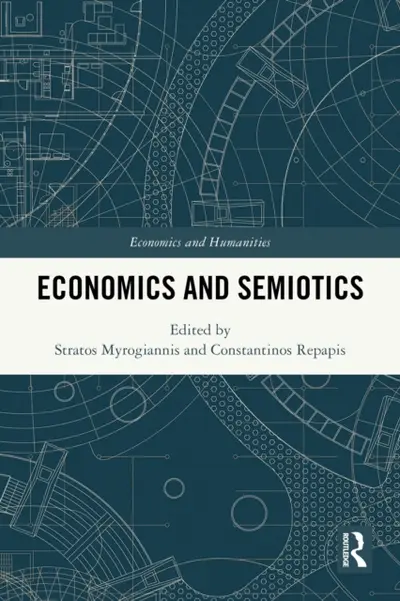
Economics and Semiotics
Price and availability
$64.99
Available in: Andorra, Austria, Australia, Belgium, Bulgaria, Canada, Switzerland, Cyprus, Czechia, Germany, Denmark, Estonia, Spain, Finland, France, United Kingdom, Guernsey, Greece, Croatia, Hungary, Ireland, Isle of Man, Iceland, Italy, Jersey, Japan, Liechtenstein, Lithuania, Luxembourg, Latvia, Monaco, Malta, Netherlands, Norway, Poland, Portugal, Romania, Sweden, Slovenia, Slovakia, San Marino, United States, Vatican City, South Africa
Stores: US, UK, Canada, EU, Australia.
Sign in to buyThe price is re-checked by the server before payment.
For personal use under the eBook licence.
- Format
- DRM
- Not stated by the publisher
- Language
- English
- Publisher
- Taylor & Francis
- Published
- 30 June 2025
- ISBN
- 9781040389362
- Subjects
- linguistics, Literary theory, Semiotics / semiology, Economic theory & philosophy, Political economy, Economic history, Interdisciplinary studies, Economic theory and philosophy, Economic history
About this book
Everything in our world can be interpreted as a sign. This opens up the question: How do we proceed from semantics to pragmatics, from theory to practice and vice versa? What is the nature of the relation between interpretation, action and reality? And, what can we learn by viewing economics and the economy through this lens?This volume gathers together a broad range of scholars in order to address issues relating to the intersection of economics and semiotic theory. Using concepts from the fields of economics and semiotics, the contributors to this volume revisit past and present theories and reinterpret models of thought and expression to show that our preconceptions about the economy can be fruitfully challenged and gain depth through a semiotic lens. The application of the semiotics approach to economics discourse is vital in helping us to examine topics that range from theory and economic history to the development of key economic ideas and concepts. The volume aims to enhance our understanding of how economic agents act, and our conceptualization of the economy and its cultural products can be reimagined.This volume will be of great interest to economists, literary scholars and students in the humanities.
Bibliographic data © Gardners Books Ltd.