EPUB · English
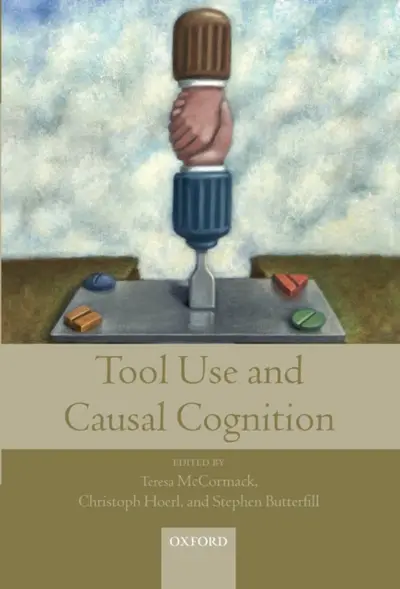
Tool Use and Causal Cognition
Price and availability
$51.99
Available in: Andorra, Austria, Australia, Belgium, Bulgaria, Canada, Switzerland, Cyprus, Czechia, Germany, Denmark, Estonia, Spain, Finland, France, United Kingdom, Guernsey, Greece, Croatia, Hungary, Ireland, Isle of Man, Iceland, Italy, Jersey, Japan, Liechtenstein, Lithuania, Luxembourg, Latvia, Monaco, Malta, Netherlands, Norway, Poland, Portugal, Romania, Sweden, Slovenia, Slovakia, San Marino, United States, Vatican City, South Africa
Stores: US, UK, Canada, EU, Australia.
Sign in to buyThe price is re-checked by the server before payment.
For personal use under the eBook licence.
- Format
- EPUB
- DRM
- Not stated by the publisher
- Language
- English
- Publisher
- Oxford University Press
- Published
- 25 August 2011
- ISBN
- 9780191625442
- Subjects
- Animal behaviour, Cognitive studies, Child, developmental and lifespan psychology, Cognition and cognitive psychology, Neurosciences, Ethology and animal behaviour, Philosophy of mind
About this book
What cognitive abilities underpin the use of tools, and how are tools and their properties represented or understood by tool-users? Does the study of tool use provide us with a unique or distinctive source of information about the causal cognition of tool-users? Tool use is a topic of major interest to all those interested in animal cognition, because it implies that the animal has knowledge of the relationship between objects and their effects. There are countless examples of animals developing tools to achieve some goal-chimps sharpening sticks to use as spears, bonobos using sticks to fish for termites, and New Caledonian crows developing complex tools to extracts insects from logs. Studies of tool use have been used to examine an exceptionally wide range of aspects of cognition, such as planning, problem-solving and insight, naive physics, social relationship between action and perception. A key debate in recent research on animal cognition concerns the level of cognitive sophistication that is implied by animal tool use, and developmental psychologists have been addressing related questions regarding the processes through which children acquire the ability to use tools. In neuropsychology, patterns of impairments in tool use due to brain damage, and studies of neural changes associated with tool use, have also led to debates about the different types of cognitive abilities that might underpin tool use, and about how tool use may change the way space or the body is represented. Tool Use and Causal Cognition provides a new interdisciplinary perspective on these issues with contributions from leading psychologists studying tool use and philosophers providing new analyses of the nature of causal understandingA ground-breaking volume which covers several disciplines, this volume will be of interest to psychologists, including animal researchers and developmental psychologists as well as philosophers, and neuroscientists.
Bibliographic data © Gardners Books Ltd.