PDF · English
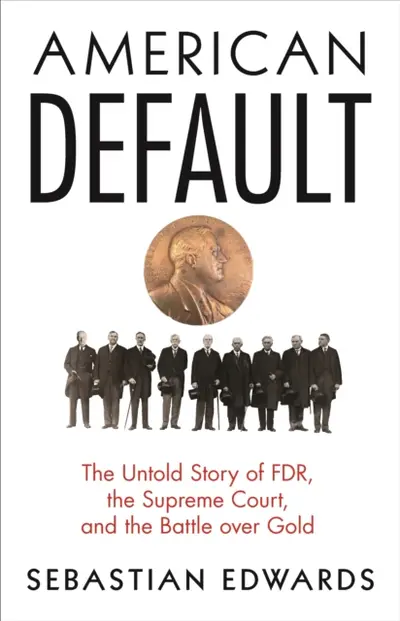
American Default
The Untold Story of FDR, the Supreme Court, and the Battle over Gold
Price and availability
$22.99
Available in: Andorra, Austria, Australia, Belgium, Bulgaria, Canada, Switzerland, Cyprus, Czechia, Germany, Denmark, Estonia, Spain, Finland, France, United Kingdom, Guernsey, Greece, Croatia, Hungary, Ireland, Isle of Man, Iceland, Italy, Jersey, Japan, Liechtenstein, Lithuania, Luxembourg, Latvia, Monaco, Malta, Netherlands, Norway, Poland, Portugal, Romania, Sweden, Slovenia, Slovakia, San Marino, United States, Vatican City, South Africa
Stores: US, UK, Canada, EU, Australia.
Sign in to buyThe price is re-checked by the server before payment.
For personal use under the eBook licence.
- Format
- DRM
- Not stated by the publisher
- Language
- English
- Publisher
- Princeton University Press
- Published
- 29 May 2018
- ISBN
- 9781400890385
- Subjects
- USA, c 1918 to c 1939 (Inter-war period), Central government policies, Monetary economics, Political economy, Economic & financial crises & disasters, Economic history, Public finance, Central / national / federal government policies, Monetary economics, Political economy, Economic history
About this book
The untold story of how FDR did the unthinkable to save the American economyThe American economy is strong in large part because nobody believes that America would ever default on its debt. Yet in 1933, Franklin D. Roosevelt did just that, when in a bid to pull the country out of depression, he depreciated the U.S. dollar in relation to gold, effectively annulling all debt contracts. American Default is the story of this forgotten chapter in America's history.Sebastian Edwards provides a compelling account of the economic and legal drama that embroiled a nation already reeling from global financial collapse. It began on April 5, 1933, when FDR ordered Americans to sell all their gold holdings to the government. This was followed by the abandonment of the gold standard, the unilateral and retroactive rewriting of contracts, and the devaluation of the dollar. Anyone who held public and private debt suddenly saw its value reduced by nearly half, and debtors--including the U.S. government-suddenly owed their creditors far less. Revaluing the dollar imposed a hefty loss on investors and savers, many of them middle-class American families. The banks fought back, and a bitter battle for gold ensued. In early 1935, the case went to the Supreme Court. Edwards describes FDR's rancorous clashes with conservative Chief Justice Charles Evans Hughes, a confrontation that threatened to finish the New Deal for good-and that led to FDR's attempt to pack the court in 1937.At a time when several major economies never approached the brink of default or devaluing or recalling currencies, American Default is a timely account of a little-known yet drastic experiment with these policies, the inevitable backlash, and the ultimate result.
Bibliographic data © Gardners Books Ltd.