PDF · English
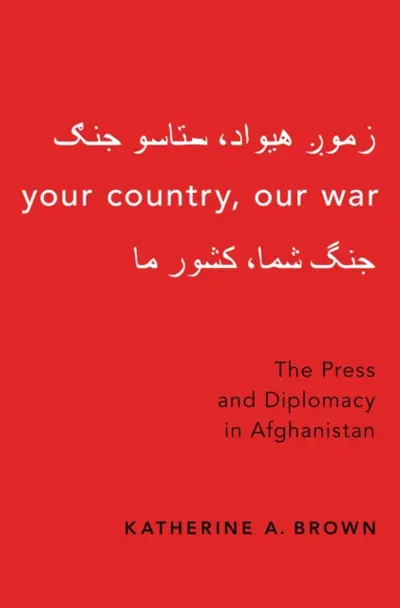
Your Country, Our War
The Press and Diplomacy in Afghanistan
Price and availability
$29.99
Available in: Andorra, Austria, Australia, Belgium, Bulgaria, Canada, Switzerland, Cyprus, Czechia, Germany, Denmark, Estonia, Spain, Finland, France, United Kingdom, Guernsey, Greece, Croatia, Hungary, Ireland, Isle of Man, Iceland, Italy, Jersey, Japan, Liechtenstein, Lithuania, Luxembourg, Latvia, Monaco, Malta, Netherlands, Norway, Poland, Portugal, Romania, Sweden, Slovenia, Slovakia, San Marino, United States, Vatican City, South Africa
Stores: US, UK, Canada, EU, Australia.
Sign in to buyThe price is re-checked by the server before payment.
For personal use under the eBook licence.
- Format
- DRM
- Not stated by the publisher
- Language
- English
- Publisher
- Oxford University Press
- Published
- 1 February 2019
- ISBN
- 9780190879426
- Subjects
- Afghanistan, International relations, Press & journalism, International relations, KNTP2
About this book
Journalists are actors in international relations, mediating communications between governments and publics, but also between the administrations of different countries. American and foreign officials simultaneously consume the work of U.S. journalists and use it in their own thinking about how to conduct their work. As such, journalists play an unofficial diplomatic role. However, the U.S. news media largely amplifies American power. Instead of stimulating greater understanding, the U.S. elite, mainstream press can often widen mistrust as they promote an American worldview and, with the exception of some outliers, reduce the world into a tight security frame in which the U.S. is the hegemon. This has been the case in Afghanistan since 2001, particularly as emerging Afghan journalists have relied significantly on U.S. and other Western news outlets to report events within their government and their country. Based on eight years of interviews in Kabul, Washington, and New York, Your Country, Our War demonstrates how news has intersected with international politics during the War in Afghanistan and shows the global power and reach of the U.S. news media, especially within the context of the post-9/11 era. It reviews the trajectory of the U.S. news narrative about Afghanistan and America's never-ending war, and the rise of Afghan journalism, from 2001 to 2017. The book also examines the impact of the American news media inside a war theater. It examines how U.S. journalists affected the U.S.-Afghan relationship and chronicles their contribution to the rapid development of a community of Afghan journalists who grappled daily with how to define themselves and their country during a tumultuous and uneven transition from fundamentalist to democratic rule. Providing rich detail about the U.S.-Afghan relationship, especially former President of Afghanistan Hamid Karzai's convictions about the role of the Western press, we begin to understand how journalists are not merely observers to a story; they are participants in it.
Bibliographic data © Gardners Books Ltd.