PDF · English
Scheduling Variable Capacity Resources for Sustainability
Price and availability
$155.99
Available in: Andorra, Austria, Australia, Belgium, Bulgaria, Canada, Switzerland, Cyprus, Czechia, Germany, Denmark, Estonia, Spain, Finland, France, United Kingdom, Guernsey, Greece, Croatia, Hungary, Ireland, Isle of Man, Iceland, Italy, Jersey, Japan, Liechtenstein, Lithuania, Luxembourg, Latvia, Monaco, Malta, Netherlands, Norway, Poland, Portugal, Romania, Sweden, Slovenia, Slovakia, San Marino, United States, Vatican City, South Africa
Stores: US, UK, Canada, EU, Australia.
Sign in to buyThe price is re-checked by the server before payment.
For personal use under the eBook licence.
- Format
- DRM
- Not stated by the publisher
- Language
- English
- Publisher
- CRC Press
- Published
- 20 April 2026
- ISBN
- 9781040538500
- Subjects
- Energy industries & utilities, Sustainability, Information technology: general issues, Computer science, Climate change, Alternative and renewable energy sources and technology, Cloud computing
About this book
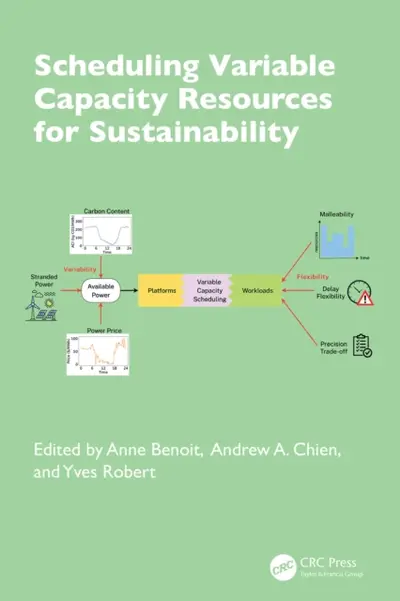
This book is the first to provide an overview of variable capacity scheduling and how it helps balance the growth of computing with its increasing environmental impact by creating more resilient and efficient systems that adapt to the dynamic nature of resource availability, optimizing utilization and minimizing disruptions. The book covers all aspects of variable capacity scheduling from a technical and a societal perspective. It considers the new age of renewable power generation and how computing services can contribute to sustainability and grid decarbonization. Contributors investigate techniques that can be deployed for schedulers to cope with, or even benefit from, changes in the number of computing resources and the nature of the power sources. They survey emerging computing devices, such as edge servers, as alternatives to classical cloud computing platforms; they identify applications for monitoring energy and regulating power; and they investigate energy minimization and risk-aware scheduling in real-time systems, asking: 'How can a server with a variable processing speed schedule jobs with hard deadlines while minimizing its energy consumption?' The authors address the societal impact of computing, exploring how the social sciences play a critical role in solving the computing sustainability challenge and including a holistic analysis of current and future approaches, taking the whole life-cycle and rebound effects into account. Presenting all the corresponding challenges and opportunities of variable capacity scheduling, this is an excellent introduction to the topic for students, researchers, computing scientists, or concerned citizens interested in sustainability.
Bibliographic data © Gardners Books Ltd.