EPUB · English
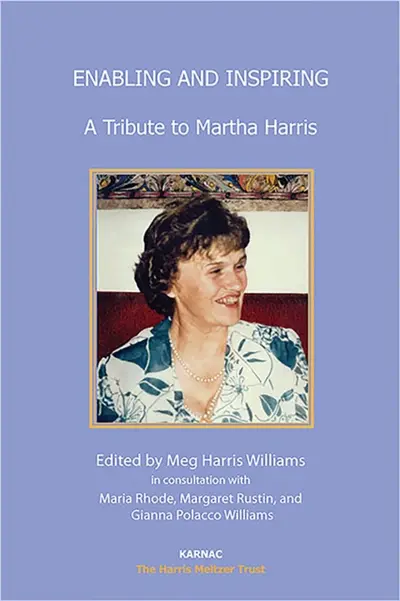
Enabling and Inspiring
A Tribute to Martha Harris
Price and availability
$55.99
Available in: Andorra, Austria, Australia, Belgium, Bulgaria, Canada, Switzerland, Cyprus, Czechia, Germany, Denmark, Estonia, Spain, Finland, France, United Kingdom, Guernsey, Greece, Croatia, Hungary, Ireland, Isle of Man, Iceland, Italy, Jersey, Japan, Liechtenstein, Lithuania, Luxembourg, Latvia, Monaco, Malta, Netherlands, Norway, Poland, Portugal, Romania, Sweden, Slovenia, Slovakia, San Marino, United States, Vatican City, South Africa
Stores: US, UK, Canada, EU, Australia.
Sign in to buyThe price is re-checked by the server before payment.
For personal use under the eBook licence.
- Format
- EPUB
- DRM
- Not stated by the publisher
- Language
- English
- Publisher
- Karnac Books
- Published
- 30 September 2012
- ISBN
- 9781781811535
- Subjects
- Psychoanalytical theory (Freudian psychology), Psychoanalytical and Freudian psychology
About this book
Martha Harris (1919-1987) was one of the most influential and also one of the most loved psychoanalysts of the generation that trained with Melanie Klein. She also worked with Wilfred Bion, and wrote many books and papers on psychoanalytic training and child development. Her colleague James Gammill cites Mrs Klein as saying: "e;She is one of the best people I have ever known for the psychoanalysis of children ... and she has a mind of her own."e; Harris was responsible for the child psychotherapy training at the Tavistock Clinic from 1960 onwards, developing laterally the method founded on infant observation that had been put in place by Esther Bick. She established cross-clinic work discussion groups, a pioneering schools' counselling course (in collaboration with her husband Roland Harris), and individual work with disturbed children in the school environment. Her belief that psychoanalytic ideas could and should "e;travel"e;, both geographically and across the professions, led to her seeding the "e;Tavi Model"e; in many other countries through regular teaching trips, in company with her later husband Donald Meltzer. Her influence was not as a theorist, but as a teacher with an extraordinary capacity to engage processes of introjective learning in both students and readers. This tribute by some of those who studied with her is not simply testimony to a remarkable teacher and clinician whose wisdom has been rarely equalled; it also offers inspiration to others who may be struggling to find ways of using psychoanalytic ideas imaginatively in a variety of contexts clinical, social or scholarly in what can at times appear to be an unreceptive world.
Bibliographic data © Gardners Books Ltd.