PDF · English
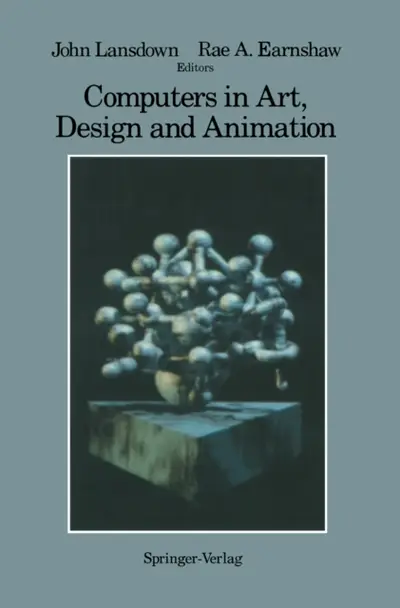
Computers in Art, Design and Animation
Price and availability
$60.99
Available in: Andorra, Austria, Australia, Belgium, Bulgaria, Canada, Switzerland, Cyprus, Czechia, Germany, Denmark, Estonia, Spain, Finland, France, United Kingdom, Guernsey, Greece, Croatia, Hungary, Ireland, Isle of Man, Iceland, Italy, Jersey, Japan, Liechtenstein, Lithuania, Luxembourg, Latvia, Monaco, Malta, Netherlands, Norway, Poland, Portugal, Romania, Sweden, Slovenia, Slovakia, San Marino, United States, Vatican City, South Africa
Stores: US, UK, Canada, EU, Australia.
Sign in to buyThe price is re-checked by the server before payment.
For personal use under the eBook licence.
- Format
- DRM
- Not stated by the publisher
- Language
- English
- Publisher
- Springer New York
- Published
- 6 December 2012
- ISBN
- 9781461245384
- Subjects
- History of art / art & design styles, Electronic, holographic & video art, Graphical & digital media applications, Computer science, Painting & art manuals, The Arts: art forms, Graphics programming
About this book
The collection of papers that makes up this book arises largely from the joint activities of two specialist groups of the British Computer Society, namely the Displays Group and the Computer Arts Society. Both these groups are now more than 20 years old and during the whole of this time have held regular, separate meetings. In recent years, however, the two groups have held a joint annual meeting at which presentations of mutual interest have been given and it is mainly from the last two of these that the present papers have been drawn. They fall naturally into four classes: visualisation, art, design and animation-although, as in all such cases, the boundaries between the classes are fuzzy and overlap inevitably occurs. Visualisation The graphic potential of computers has been recognised almost since computing was first used, but it is only comparatively recently that their possibilities as devices for the visualisation of complex. and largely ab- stract phenomena has begun to be more fully appreciated. Some workers stress the need to be able to model photographic reality in order to assist in this task. They look to better algorithms and more resolution to achieve this end. Others-Alan Mackay for instance-suggest that it is "e;not just a matter of providing more and more pixels. It is a matter of providing congenial clues which employ to the greatest extent what we already know.
Bibliographic data © Gardners Books Ltd.