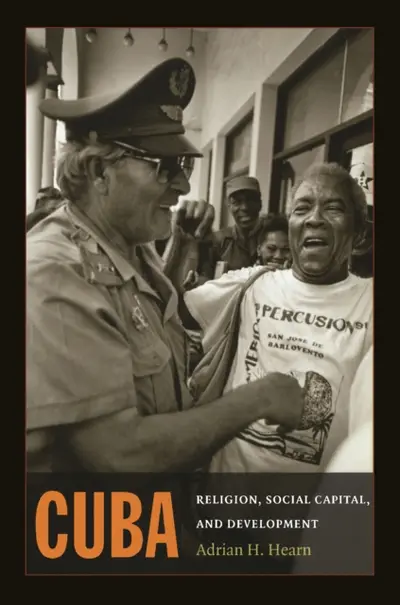
PDF · English
Cuba
Religion, Social Capital, and Development
Price and availability
$43.99
Available in: Andorra, Austria, Australia, Belgium, Bulgaria, Canada, Switzerland, Cyprus, Czechia, Germany, Denmark, Estonia, Spain, Finland, France, United Kingdom, Guernsey, Greece, Croatia, Hungary, Ireland, Isle of Man, Iceland, Italy, Jersey, Japan, Liechtenstein, Lithuania, Luxembourg, Latvia, Monaco, Malta, Netherlands, Norway, Poland, Portugal, Romania, Sweden, Slovenia, Slovakia, San Marino, United States, Vatican City, South Africa
Stores: US, UK, Canada, EU, Australia.
Sign in to buyThe price is re-checked by the server before payment.
For personal use under the eBook licence.
- Format
- DRM
- Not stated by the publisher
- Language
- English
- Publisher
- Duke University Press
- Published
- 18 August 2008
- ISBN
- 9780822389484
- Subjects
- Cuba, History of the Americas, Christianity, Religious groups: social & cultural aspects, Social & cultural anthropology, ethnography, Social welfare & social services, Cuba, JBSR, Social and cultural anthropology, Social welfare, social policy and social services, NHK, QRM
About this book
When Cuba's centralized system for providing basic social services began to erode in the early 1990s, Christian and Afro-Cuban religious groups took on new social and political responsibilities. They began to work openly with state institutions on projects such as the promotion of Afro-Cuban heritage to encourage tourism, and community welfare initiatives to confront drug use, prostitution, and housing decay. In this rich ethnography, the anthropologist Adrian H. Hearn provides a detailed, on-the-ground analysis of how the Cuban state and local religious groups collaborate on community development projects and work with the many foreign development agencies operating in Cuba. Hearn argues that the growing number of collaborations between state and non-state actors has begun to consolidate the foundations of a civil society in Cuba.While conducting research, Hearn lived for one year each in two Santeria temple-houses: one located in Old Havana and the other in Santiago de Cuba. During those stays he conducted numerous interviews: with the historian of Havana and the conservationist of Santiago de Cuba (officials roughly equivalent to mayors in the United States), acclaimed writers, influential leaders of Afro-Cuban religions, and many citizens involved in community development initiatives. Hearn draws on those interviews, his participant observation in the temple-houses, case studies, and archival research to convey the daily life experiences and motivations of religious practitioners, development workers, and politicians. Using the concept of social capital, he explains the state's desire to incorporate tightly knit religious groups into its community development projects, and he illuminates a fundamental challenge facing Cuba's religious communities: how to maintain their spiritual integrity and internal solidarity while participating in state-directed projects.
Bibliographic data © Gardners Books Ltd.