PDF · English
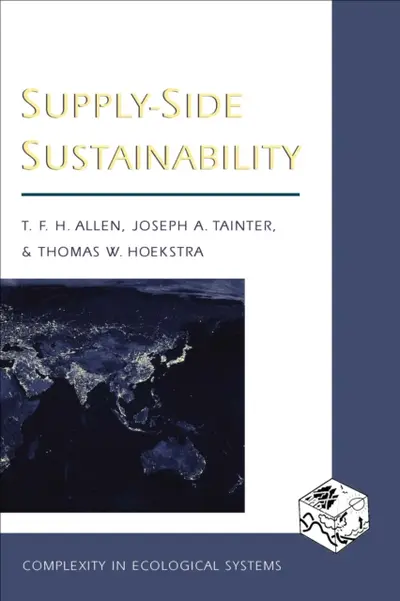
Supply-Side Sustainability
Price and availability
$74.99
Available in: Andorra, Austria, Australia, Belgium, Bulgaria, Canada, Switzerland, Cyprus, Czechia, Germany, Denmark, Estonia, Spain, Finland, France, United Kingdom, Guernsey, Greece, Croatia, Hungary, Ireland, Isle of Man, Iceland, Italy, Jersey, Japan, Liechtenstein, Lithuania, Luxembourg, Latvia, Monaco, Malta, Netherlands, Norway, Poland, Portugal, Romania, Sweden, Slovenia, Slovakia, San Marino, United States, Vatican City, South Africa
Stores: US, UK, Canada, EU, Australia.
Sign in to buyThe price is re-checked by the server before payment.
For personal use under the eBook licence.
- Format
- DRM
- Not stated by the publisher
- Language
- English
- Publisher
- Columbia University Press
- Published
- 19 February 2003
- ISBN
- 9780231504072
- Subjects
- The environment, Sustainability, The environment, Sustainability
About this book
While environmentalists insist that lower rates of consumption of natural resources are essential for a sustainable future, many economists dismiss the notion that resource limits act to constrain modern, creative societies. The conflict between these views tinges political debate at all levels and hinders our ability to plan for the future.Supply-Side Sustainability offers a fresh approach to this dilemma by integrating ecological and social science approaches in an interdisciplinary treatment of sustainability. Written by two ecologists and an anthropologist, this book discusses organisms, landscapes, populations, communities, biomes, the biosphere, ecosystems and energy flows, as well as patterns of sustainability and collapse in human societies, from hunter-gatherer groups to empires to today's industrial world. These diverse topics are integrated within a new framework that translates the authors' advances in hierarchy and complexity theory into a form useful to professionals in science, government, and business.The result is a much-needed blueprint for a cost-effective management regime, one that makes problem-solving efforts themselves sustainable over time. The authors demonstrate that long-term, cost-effective resource management can be achieved by managing the contexts of productive systems, rather than by managing the commodities that natural systems produce.
Bibliographic data © Gardners Books Ltd.