EPUB · English
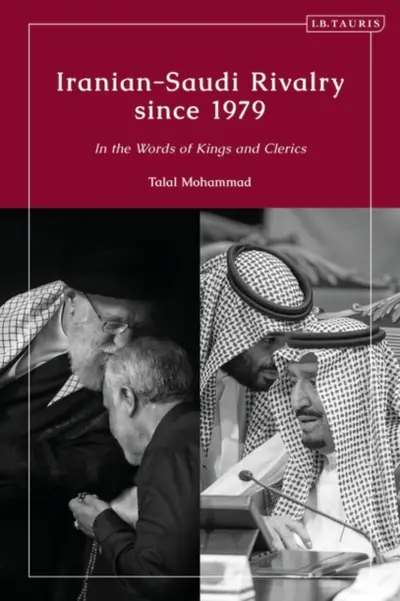
Iranian-Saudi Rivalry since 1979
In the Words of Kings and Clerics
Price and availability
$36.99
Available in: Andorra, Austria, Australia, Belgium, Bulgaria, Canada, Switzerland, Cyprus, Czechia, Germany, Denmark, Estonia, Spain, Finland, France, United Kingdom, Guernsey, Greece, Croatia, Hungary, Ireland, Isle of Man, Iceland, Italy, Jersey, Japan, Liechtenstein, Lithuania, Luxembourg, Latvia, Monaco, Malta, Netherlands, Norway, Poland, Portugal, Romania, Sweden, Slovenia, Slovakia, San Marino, United States, Vatican City, South Africa
Stores: US, UK, Canada, EU, Australia.
Sign in to buyThe price is re-checked by the server before payment.
For personal use under the eBook licence.
- Format
- EPUB
- DRM
- Not stated by the publisher
- Language
- English
- Publisher
- Bloomsbury Publishing
- Published
- 11 August 2022
- Pages
- 480
- ISBN
- 9780755634743
- Subjects
- Iran, Saudi Arabia, linguistics, Asian history, Middle Eastern history, Religion & beliefs, Religion & politics, Religious intolerance, persecution & conflict, Islamic studies, Politics & government, Political leaders & leadership, International relations, Geopolitics, Linguistics, JBSR, Politics and government, Political leaders and leadership, International relations, Geopolitics, NHF, NHG, QR, QRAM2, QRAM9
About this book
The fraught relationship between Saudi Arabia and Iran is usually attributed to sectarian differences, even by the states' own elites. However, this book shows that in their official speeches, newspaper editorials and Friday sermons, these elites use sectarian and nationalist references and tropes to denigrate each other and promote themselves in the eyes of their respective constituencies in the region. Talal Mohammad, who is fluent in both Arabic and Persian, examines Saudi-Iranian rivalry using discourse analysis of these religious, political and journalistic sources. Tracing what has been produced since 1979 in parallel, he argues for a consistent pattern of mutual misrepresentation, whereby each frames its counterpart as the 'Other' to which a specific political agenda can be justified and advanced. The book covers key events including the Iranian Revolution, the invasion of Kuwait in 1990, the Taliban war, the fall of Saddam, the Arab Spring, the rise of Mohammed bin Salman, and the war on ISIS. While until now Saudi-Iranian rivalry has been understood in primarily sectarian or geopolitical terms, the author argues here that the discursive othering serves as a propagandist function that supports more fundamental political and geopolitical considerations.
Bibliographic data © Gardners Books Ltd.