PDF · English
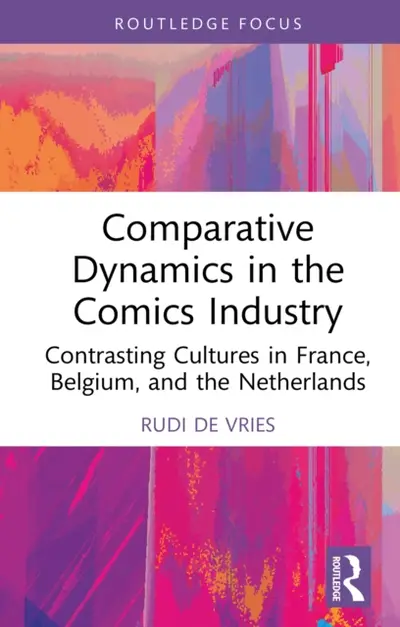
Comparative Dynamics in the Comics Industry
Contrasting Cultures in France, Belgium, and the Netherlands
Price and availability
$33.99
Available in: Andorra, Austria, Australia, Belgium, Bulgaria, Canada, Switzerland, Cyprus, Czechia, Germany, Denmark, Estonia, Spain, Finland, France, United Kingdom, Guernsey, Greece, Croatia, Hungary, Ireland, Isle of Man, Iceland, Italy, Jersey, Japan, Liechtenstein, Lithuania, Luxembourg, Latvia, Monaco, Malta, Netherlands, Norway, Poland, Portugal, Romania, Sweden, Slovenia, Slovakia, San Marino, United States, Vatican City, South Africa
Stores: US, UK, Canada, EU, Australia.
Sign in to buyThe price is re-checked by the server before payment.
For personal use under the eBook licence.
- Format
- DRM
- Not stated by the publisher
- Language
- English
- Publisher
- Taylor & Francis
- Published
- 1 April 2025
- ISBN
- 9781040353219
- Subjects
- Research methods: general, Popular culture, Media studies, Sociology: work & labour, Organizational theory & behaviour, Media, information & communication industries, Information technology industries, Cultural and media studies, Organizational theory and behaviour, Publishing and book trade
About this book
Due to the enormous cultural and economic impact of the Marvel movies, manga, and anime, research on the comics industry is growing, but has focused primarily on the US and Japan. This book focusses on the European comics industry to explore the complex impact of organizational and cultural differences in audience behaviours, both in the comics industry specifically and in the creative industries in general.Drawing on the author's research on the contrasting comics culture of the Netherlands, Belgium, and France, the study uses institutional theories and organizational ecology to compare the interactions of publishing organizations with artists, audiences, and each other. It combines this with a critical approach to modernization theory to evaluate how historical, cultural, and religious factors might impact the audience for comics and how those audiences respond to and interact with this specific creative medium. The book demonstrates the benefits of using combinations of theoretical frameworks to draw out more nuanced interpretations for this and other under-researched creative industry areas.With its unique insights, this book will be of great interest to researchers in the comics industry, as well as a fascinating contribution to research in cultural-related audience behaviour for all scholars in the creative industries.
Bibliographic data © Gardners Books Ltd.