PDF · English
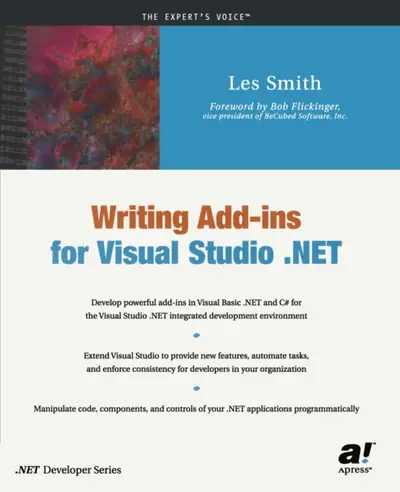
Writing Add-ins for Visual Studio .NET
Price and availability
$52.99
Available in: Andorra, Austria, Australia, Belgium, Bulgaria, Canada, Switzerland, Cyprus, Czechia, Germany, Denmark, Estonia, Spain, Finland, France, United Kingdom, Guernsey, Greece, Croatia, Hungary, Ireland, Isle of Man, Iceland, Italy, Jersey, Japan, Liechtenstein, Lithuania, Luxembourg, Latvia, Monaco, Malta, Netherlands, Norway, Poland, Portugal, Romania, Sweden, Slovenia, Slovakia, San Marino, United States, Vatican City, South Africa
Stores: US, UK, Canada, EU, Australia.
Sign in to buyThe price is re-checked by the server before payment.
For personal use under the eBook licence.
- Format
- DRM
- Not stated by the publisher
- Language
- English
- Publisher
- Apress
- Published
- 29 July 2002
- ISBN
- 9781430211013
- Subjects
- Internet guides & online services, Programming & scripting languages: general, Microsoft programming, Software Engineering
About this book
Visual Studio .NET is the most extensible development environment Microsoft has released to date. Organizations create add-ins for many purposes: to speed common tasks, to ease code reuse within an organization, and to enforce rules and consistency among developers. Effective use of add-ins can dramatically improve developer efficiency and reduce costs.Writing Add-Ins for Visual Studio .NET is designed to get add-in developers up to speed in developing ad-ins in Visual Studio .NET and to teach add-in development to developers who want to learn to write add-ins. Author Les Smith also provides enough real code examples to challenge even experienced add-in developers.Smiths book begins by teaching readers how to use the Add-In Wizard to create the basic add-in framework. From there, he covers the manipulation of code in windows and controls, and the manipulation of projects. Writing Add-Ins for Visual Studio .NET explores in detail, how to create an add-in user interface, including toolbars, toolbar buttons, and multiple-level menus, as well as how to create a user interface in the system tray. Smith also addresses the migration of add-ins from VB 6.0 to VB .NET for those developers who have previous experience in writing add-ins.One of the great challenges that add-in developers will encounter is finding the right classes from among the 3,400 classes in the .NET Framework. Smith teaches and demonstrates use of the Visual Studio add-in object model to show readers how to use the methods and properties and respond to events in order to enhance the power of the integrated development environment (IDE).
Bibliographic data © Gardners Books Ltd.