PDF · English
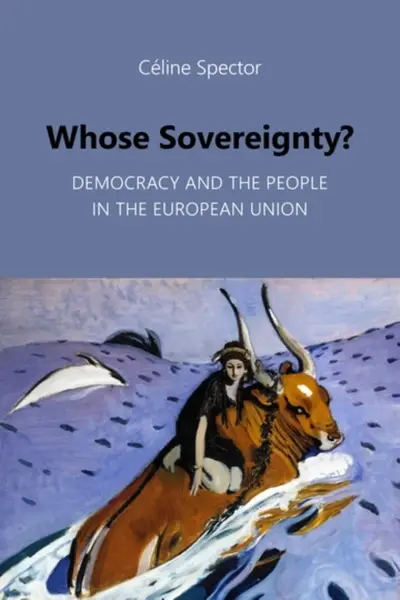
Whose Sovereignty?
Democracy and the People in the European Union
Price and availability
$101.99
Available in: Andorra, Austria, Australia, Belgium, Bulgaria, Canada, Switzerland, Cyprus, Czechia, Germany, Denmark, Estonia, Spain, Finland, France, United Kingdom, Guernsey, Greece, Croatia, Hungary, Ireland, Isle of Man, Iceland, Italy, Jersey, Japan, Liechtenstein, Lithuania, Luxembourg, Latvia, Monaco, Malta, Netherlands, Norway, Poland, Portugal, Romania, Sweden, Slovenia, Slovakia, San Marino, United States, Vatican City, South Africa
Stores: US, UK, Canada, EU, Australia.
Sign in to buyThe price is re-checked by the server before payment.
For personal use under the eBook licence.
- Format
- DRM
- Not stated by the publisher
- Language
- English
- Publisher
- Edinburgh University Press
- Published
- 30 April 2026
- ISBN
- 9781788218931
- Subjects
- EU (European Union), Social & political philosophy, Political science & theory, Nationalism, Political structures: democracy, EU (European Union), Political science and theory, Nationalism and nationalist ideologies and movements, Political structures / systems: democracy, Social and political philosophy
About this book
In this carefully argued case for a federal Europe, Celine Spector proposes that national sovereignty has become increasingly untenable as mechanisms perpetuating fiscal, social and environmental inequities transcend borders. Indeed, in the face of Russian aggression and America's apparent retreat from its protective role, strengthening European integration has become essential and federalization appears increasingly necessary.Although the concept of the sovereign people has become symbolic within nation-states, Spector show that it has become devoid of substantive political force. Rather than lamenting the decline of direct democracy, she advocates for a democratized European Union that could redefine popular sovereignty and protect human rights. The transformation of state sovereignty need not signal democracy's end or the subordination of politics to law. Instead, it could facilitate new forms of political community at the European level and enable a reconceptualization of popular sovereignty beyond the nation-state.
Bibliographic data © Gardners Books Ltd.