EPUB · English
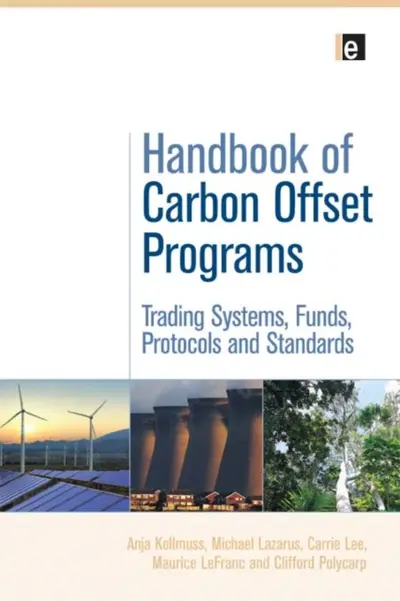
Handbook of Carbon Offset Programs
Trading Systems, Funds, Protocols and Standards
Price and availability
$72.99
Available in: Andorra, Austria, Australia, Belgium, Bulgaria, Canada, Switzerland, Cyprus, Czechia, Germany, Denmark, Estonia, Spain, Finland, France, United Kingdom, Guernsey, Greece, Croatia, Hungary, Ireland, Isle of Man, Iceland, Italy, Jersey, Japan, Liechtenstein, Lithuania, Luxembourg, Latvia, Monaco, Malta, Netherlands, Norway, Poland, Portugal, Romania, Sweden, Slovenia, Slovakia, San Marino, United States, Vatican City, South Africa
Stores: US, UK, Canada, EU, Australia.
Sign in to buyThe price is re-checked by the server before payment.
For personal use under the eBook licence.
- Format
- EPUB
- DRM
- Not stated by the publisher
- Language
- English
- Publisher
- Taylor & Francis
- Published
- 12 August 2010
- ISBN
- 9781136542572
- Subjects
- Economics, finance, business & management, Economics, Environmental economics, Commodities, Business & management, Environmental management, Climate change, World
About this book
Greenhouse gas (GHG) offsets have long been promoted as an important element of a comprehensive climate policy approach. Offset programs can reduce the overall cost of achieving a given emission goal by enabling emission reductions to occur where costs are lower. Offsets have the potential to deliver sustainability co-benefits, through technology development and transfer. They can also develop human and institutional capacity for reducing emissions in sectors and locations not included in a cap and trade or a mandatory government policy. However, offsets can pose a risk to the environmental integrity of climate actions, especially if issues surrounding additionality, permanence, leakage, quantification and verification are not adequately addressed. The challenge is to design offset programs and policies that can maximize their potential benefits while minimizing their potential risks. This handbook provides a systematic and comprehensive review of existing offset programs. It looks at what offsets are, how offset mechanisms function, and the successes and pitfalls they have encountered. Coverage includes offset programs across the full swath of applications including mandatory and voluntary systems, government regulated and private markets, carbon offset funds, and accounting and reporting protocols such as the WBCSD/WRI GHG Protocol and ISO 14064. Learning from the successes and failures of these programs will be essential to crafting effective climate policy. This is an essential reference for all regulators, policy makers, business leaders and NGOs concerned with the design and operation of GHG offset programs world-wide. Published with SEI
Bibliographic data © Gardners Books Ltd.