EPUB · English
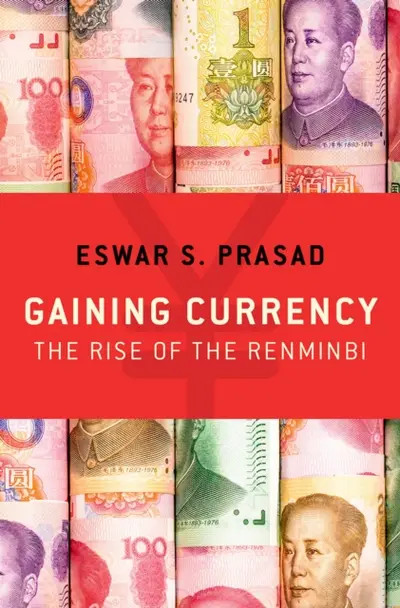
Gaining Currency
The Rise of the Renminbi
Price and availability
$39.99
Available in: Andorra, Austria, Australia, Belgium, Bulgaria, Canada, Switzerland, Cyprus, Czechia, Germany, Denmark, Estonia, Spain, Finland, France, United Kingdom, Guernsey, Greece, Croatia, Hungary, Ireland, Isle of Man, Iceland, Italy, Jersey, Japan, Liechtenstein, Lithuania, Luxembourg, Latvia, Monaco, Malta, Netherlands, Norway, Poland, Portugal, Romania, Sweden, Slovenia, Slovakia, San Marino, United States, Vatican City, South Africa
Stores: US, UK, Canada, EU, Australia.
Sign in to buyThe price is re-checked by the server before payment.
For personal use under the eBook licence.
- Format
- EPUB
- DRM
- Not stated by the publisher
- Language
- English
- Publisher
- Oxford University Press
- Published
- 13 September 2016
- ISBN
- 9780190631079
- Subjects
- China, International institutions, Monetary economics, Political economy, Economic history, Public finance, Banking, International institutions / intergovernmental organizations, Monetary economics, Political economy, Economic history, Public finance and taxation, Banking
About this book
In Gaining Currency, leading China scholar Eswar S. Prasad describes how the renminbi (RMB) is taking the world by storm and explains its role in reshaping global finance. This book sets the recent rise of the RMB, China's currency since 1949, against a sweeping historical backdrop. China issued the world's first paper currency in the 7th century. In the 13th century, Kublai Khan issued the first-ever currency to circulate widely despite not being backed by commodities or precious metals. China also experienced some of the earliest episodes of hyperinflation currency wars. Gaining Currency reveals the interconnections linking China's growing economic might, its expanding international influence, and the rise of its currency. If China plays its cards right by adopting reforms that put its economy and financial markets on the right track, the RMB could rival even the euro and the Japanese yen. Prasad shows, however, that while China has successfully adopted a unique playbook for promoting the RMB, many pitfalls lie ahead for its economy and currency that could limit the RMB's ascendance. The Chinese leadership is pursuing financial liberalization and limited market-oriented reforms, but it has unequivocally repudiated political, legal, and institutional reforms. Therefore, Prasad argues, while the RMB is likely to become a significant reserve currency, it will not attain "e;safe haven"e; status as a currency to which investors turn during crises. In short, the hype predicting the RMB's inevitable rise to global dominance is overblown. Gaining Currency makes a compelling case that, for all its promise, the RMB does not pose a serious challenge to the U.S. dollar's dominance in international finance.
Bibliographic data © Gardners Books Ltd.