EPUB · English
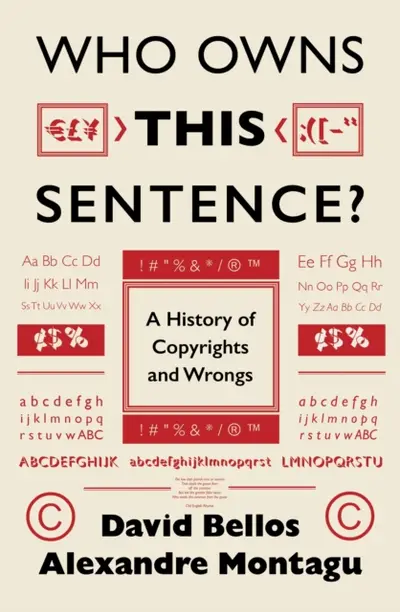
Who Owns This Sentence?
A History of Copyrights and Wrongs
Price and availability
Not sold in this region
Available in: Andorra, Austria, Australia, Belgium, Bulgaria, Switzerland, Cyprus, Czechia, Germany, Denmark, Estonia, Spain, Finland, France, United Kingdom, Guernsey, Greece, Croatia, Hungary, Ireland, Isle of Man, Iceland, Italy, Jersey, Japan, Liechtenstein, Lithuania, Luxembourg, Latvia, Monaco, Malta, Netherlands, Norway, Poland, Portugal, Romania, Sweden, Slovenia, Slovakia, San Marino, Vatican City, South Africa
Stores: UK, EU, Australia. Not available in the United States store.
This title cannot be bought in this store yet: its supplier terms, territorial rights or price are still being confirmed.
For personal use under the eBook licence.
- Format
- EPUB
- DRM
- Not stated by the publisher
- Language
- English
- Publisher
- Headline
- Published
- 18 January 2024
- ISBN
- 9781914495892
- Subjects
- Memoirs, Media studies, Social issues & processes, Social discrimination & inequality, Economic history, Memoirs, Media studies, Social and ethical issues
About this book
Copyright is everywhere. Your smartphone incorporates thousands of items of intellectual property. Someone owns the reproduction rights to photographs of your dining table. At this very moment, battles are raging over copyright in the output of artificial intelligence programs. Not only books but wallpaper, computer programs and cuddly toys are now deemed to be intellectual properties - making copyright a labyrinthine construction of laws, covering almost all products of human creativity.Copyright has its roots in eighteenth-century London, where it was first established to limit printers' control of books. Principled arguments against copyright arose from the start and nearly abolished it in the nineteenth century. But a handful of little-noticed changes in the late twentieth century concentrated ownership of immaterial goods into very few hands. Who Owns This Sentence? is an often-humorous and always-enlightening cultural, legal, and global history of the idea that intangible things can be owned, and makes a persuasive case for seeing copyright as an engine of inequality in the twenty-first century.
Bibliographic data © Gardners Books Ltd.