PDF · English
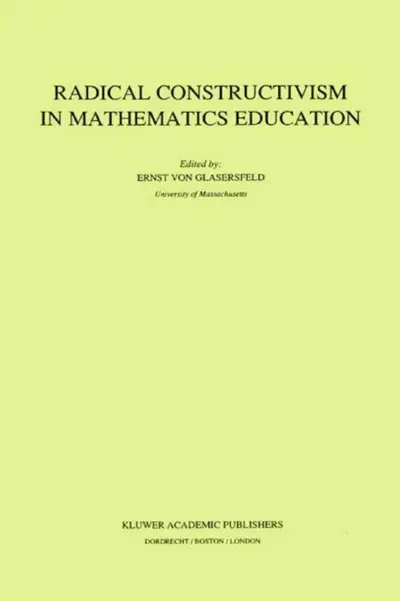
Radical Constructivism in Mathematics Education
Price and availability
$175.99
Available in: Andorra, Austria, Australia, Belgium, Bulgaria, Canada, Switzerland, Cyprus, Czechia, Germany, Denmark, Estonia, Spain, Finland, France, United Kingdom, Guernsey, Greece, Croatia, Hungary, Ireland, Isle of Man, Iceland, Italy, Jersey, Japan, Liechtenstein, Lithuania, Luxembourg, Latvia, Monaco, Malta, Netherlands, Norway, Poland, Portugal, Romania, Sweden, Slovenia, Slovakia, San Marino, United States, Vatican City, South Africa
Stores: US, UK, Canada, EU, Australia.
Sign in to buyThe price is re-checked by the server before payment.
For personal use under the eBook licence.
- Format
- DRM
- Not stated by the publisher
- Language
- English
- Publisher
- Springer Netherlands
- Published
- 11 April 2006
- ISBN
- 9780306472015
- Subjects
- Philosophy & theory of education, Teaching of a specific subject, Mathematics, Philosophy and theory of education, Teaching of a specific subject, Mathematics
About this book
Mathematics is the science of acts without things - and through this, of things one can define by acts. 1 Paul Valery The essays collected in this volume form a mosaik of theory, research, and practice directed at the task of spreading mathematical knowledge. They address questions raised by the recurrent observation that, all too frequently, the present ways and means of teaching mathematics generate in the student a lasting aversion against numbers, rather than an understanding of the useful and sometimes enchanting things one can do with them. Parents, teachers, and researchers in the field of education are well aware of this dismal situation, but their views about what causes the wide-spread failure and what steps should be taken to correct it have so far not come anywhere near a practicable consensus. The authors of the chapters in this book have all had extensive experience in teaching as well as in educational research. They approach the problems they have isolated from their own individual perspectives. Yet, they share both an overall goal and a specific fundamental conviction that characterized the efforts about which they write here. The common goal is to find a better way to teach mathematics. The common conviction is that knowledge cannot simply be transferred ready-made from parent to child or from teacher to student but has to be actively built up by each learner in his or her own mind.
Bibliographic data © Gardners Books Ltd.