PDF · English
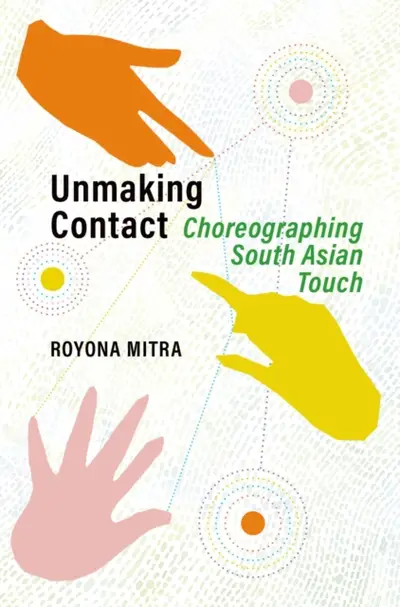
Unmaking Contact
Choreographing South Asian Touch
Price and availability
$25.99
Available in: Andorra, Austria, Australia, Belgium, Bulgaria, Canada, Switzerland, Cyprus, Czechia, Germany, Denmark, Estonia, Spain, Finland, France, United Kingdom, Guernsey, Greece, Croatia, Hungary, Ireland, Isle of Man, Iceland, Italy, Jersey, Japan, Liechtenstein, Lithuania, Luxembourg, Latvia, Monaco, Malta, Netherlands, Norway, Poland, Portugal, Romania, Sweden, Slovenia, Slovakia, San Marino, United States, Vatican City, South Africa
Stores: US, UK, Canada, EU, Australia.
Sign in to buyThe price is re-checked by the server before payment.
For personal use under the eBook licence.
- Format
- DRM
- Not stated by the publisher
- Language
- English
- Publisher
- Oxford University Press
- Published
- 21 March 2025
- ISBN
- 9780197627785
- Subjects
- Dance & other performing arts, Folk dancing, Other performing arts, ATQ, ATQZ, ATX
About this book
Unmaking Contact interrogates "e;contact"e;, understood in Global North dance discourse as a shorthand for the movement discipline of contact improvisation (CI) and its characteristic shifting points of weight-sharing between two or more bodies through physical touch, by attending to power asymmetries that are foundational to this practice. By placing South Asian aesthetics, bodies, discourses, and philosophies on touch at the heart of its interrogation through the lenses of caste, ecology, faith, gender, and sexuality, author Royona Mitra argues for an intersectional, intercultural, and inter-epistemic understanding of contact, that may or may not involve touch. The book shifts and expands understandings of contact in dance-making through intercultural epistemologies that examine notions of touch and contact. In this book the term contact signals both a shorthand for CI and a shift away from it to more expansive choreographic considerations. It becomes an apparatus for dismantling power regimes; it is conjured as a catalyst to examine power in social relations; it appears as a fulcrum of ecological relationality; it arises as critical encounters full of generative and transformative potential; and finally, it manifests as community.
Bibliographic data © Gardners Books Ltd.