PDF · English
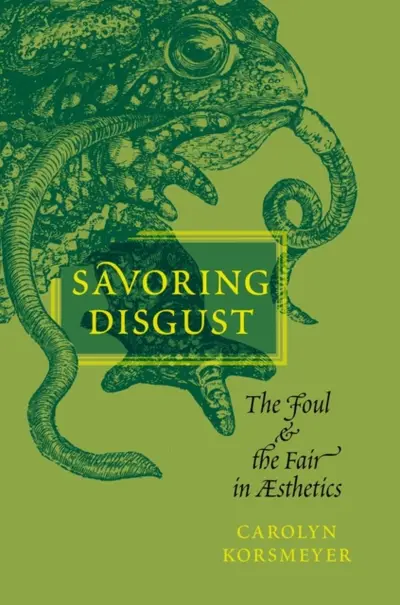
Savoring Disgust
The Foul and the Fair in Aesthetics
Price and availability
$47.99
Available in: Andorra, Austria, Australia, Belgium, Bulgaria, Canada, Switzerland, Cyprus, Czechia, Germany, Denmark, Estonia, Spain, Finland, France, United Kingdom, Guernsey, Greece, Croatia, Hungary, Ireland, Isle of Man, Iceland, Italy, Jersey, Japan, Liechtenstein, Lithuania, Luxembourg, Latvia, Monaco, Malta, Netherlands, Norway, Poland, Portugal, Romania, Sweden, Slovenia, Slovakia, San Marino, United States, Vatican City, South Africa
Stores: US, UK, Canada, EU, Australia.
Sign in to buyThe price is re-checked by the server before payment.
For personal use under the eBook licence.
- Format
- DRM
- Not stated by the publisher
- Language
- English
- Publisher
- Oxford University Press
- Published
- 17 March 2011
- ISBN
- 9780199842346
- Subjects
- Theory of art, Philosophy: aesthetics, Material culture, Theory of art, JBCC2, QDTN
About this book
Disgust is among the strongest of aversions, characterized by involuntary physical recoil and even nausea. Yet paradoxically, disgusting objects can sometimes exert a grisly allure, and this emotion can constitute a positive, appreciative aesthetic response when exploited by works of art -- a phenomenon labelled here "e;aesthetic disgust."e; While the reactive, visceral quality of disgust contributes to its misleading reputation as a relatively "e;primitive"e; response mechanism, it is this feature that also gives it a particular aesthetic power when manifest in art. Most treatments of disgust mistakenly interpret it as only an extreme response, thereby neglecting the many subtle ways that it operates aesthetically. This study calls attention to the diversity and depth of its uses, analyzing the emotion in detail and considering the enormous variety of aesthetic forms it can assume in works of art and --unexpectedly-- even in foods. In the process of articulating a positive role for disgust, this book examines the nature of aesthetic apprehension and argues for the distinctive mode of cognition that disgust affords -- an intimate apprehension of physical mortality. Despite some commonalities attached to the meaning of disgust, this emotion assumes many aesthetic forms: it can be funny, profound, witty, ironic, unsettling, sorrowful, or gross. To demonstrate this diversity, several chapters review examples of disgust as it is aroused by art. The book ends by investigating to what extent disgust can be discovered in art that is also considered beautiful.
Bibliographic data © Gardners Books Ltd.