PDF · English
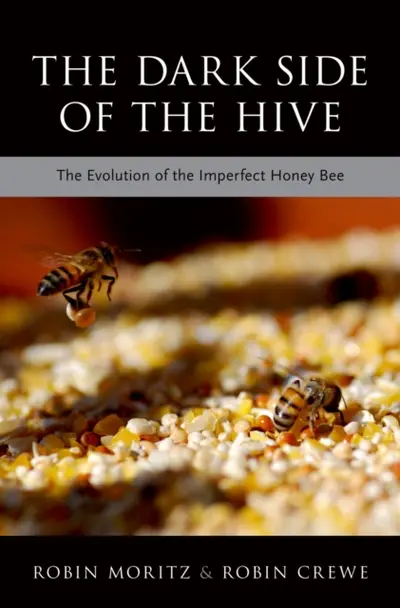
Dark Side of the Hive
The Evolution of the Imperfect Honeybee
Price and availability
$91.99
Available in: Andorra, Austria, Australia, Belgium, Bulgaria, Canada, Switzerland, Cyprus, Czechia, Germany, Denmark, Estonia, Spain, Finland, France, United Kingdom, Guernsey, Greece, Croatia, Hungary, Ireland, Isle of Man, Iceland, Italy, Jersey, Japan, Liechtenstein, Lithuania, Luxembourg, Latvia, Monaco, Malta, Netherlands, Norway, Poland, Portugal, Romania, Sweden, Slovenia, Slovakia, San Marino, United States, Vatican City, South Africa
Stores: US, UK, Canada, EU, Australia.
Sign in to buyThe price is re-checked by the server before payment.
For personal use under the eBook licence.
- Format
- DRM
- Not stated by the publisher
- Language
- English
- Publisher
- Oxford University Press
- Published
- 20 August 2018
- ISBN
- 9780190872298
- Subjects
- Evolution, Zoology: Invertebrates, Insects (entomology), Evolution / Evolutionary biology, PSVA, PSVA2
About this book
Honey bees have been described as exceptionally clever, well-organized, mutualistic, collaborative, busy, efficient--in short a perfect society. While the colony is indeed a marvel of harmonious, efficient organization, it also has a considerable dark side. Authors Robin Moritz and Robin Crewe write about the life history of the honey bee, Apis mellifera, highlighting conflict rather than harmony, failure rather than success, from the perspective of the individual worker in the colony. When one looks carefully, the honey bee colony is far from being perfect. As with any complex social system, honeybee societies are prone to error, robbery, cheating, and social parasitism. Nevertheless, the hive gets by remarkably well in spite of many seemingly odd biological features. The perfection that is perceived to exist in the honeybee's social organization is the function of a focus on the colony as a whole rather than exploring the idiosyncrasies of its individual members. The Dark Side of the Hive thus focuses on the role of the individual rather than that of the collective. Moritz and Crewe dissect the various careers that individual male and female honey bees can take and their role in colony organization. Competition between individuals using both physical and chemical force drives colonial organization. This book deals with individual mistakes, maladaptations and evolutionary dead-ends that are also part of the bees' life. The story told about these dark sides of the colony spans the full range of biological disciplines ranging from genomics to systems biology.
Bibliographic data © Gardners Books Ltd.