PDF · English
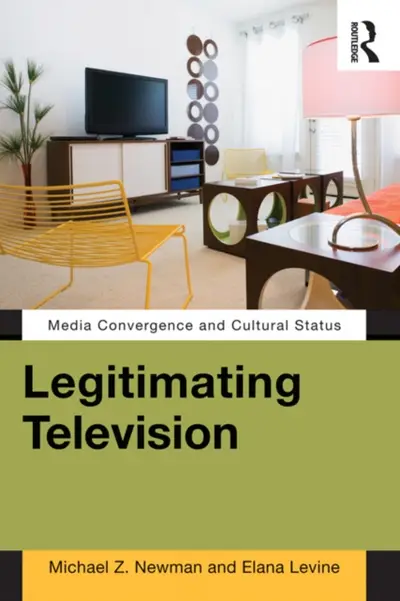
Legitimating Television
Media Convergence and Cultural Status
Price and availability
$58.99
Available in: Andorra, Austria, Australia, Belgium, Bulgaria, Canada, Switzerland, Cyprus, Czechia, Germany, Denmark, Estonia, Spain, Finland, France, United Kingdom, Guernsey, Greece, Croatia, Hungary, Ireland, Isle of Man, Iceland, Italy, Jersey, Japan, Liechtenstein, Lithuania, Luxembourg, Latvia, Monaco, Malta, Netherlands, Norway, Poland, Portugal, Romania, Sweden, Slovenia, Slovakia, San Marino, United States, Vatican City, South Africa
Stores: US, UK, Canada, EU, Australia.
Sign in to buyThe price is re-checked by the server before payment.
For personal use under the eBook licence.
- Format
- DRM
- Not stated by the publisher
- Language
- English
- Publisher
- Taylor & Francis
- Published
- 27 February 2012
- ISBN
- 9781136942730
- Subjects
- Television, Media studies, TV & society, Cultural studies, Media studies: TV and society, Social discrimination and social justice
About this book
Legitimating Television: Media Convergence and Cultural Status explores how and why television is gaining a new level of cultural respectability in the 21st century. Once looked down upon as a "e;plug-in drug"e; offering little redeeming social or artistic value, television is now said to be in a creative renaissance, with critics hailing the rise of Quality series such as Mad Men and 30 Rock. Likewise, DVDs and DVRs, web video, HDTV, and mobile devices have shifted the longstanding conception of television as a household appliance toward a new understanding of TV as a sophisticated, high-tech gadget. Newman and Levine argue that television's growing prestige emerges alongside the convergence of media at technological, industrial, and experiential levels. Television is permitted to rise in respectability once it is connected to more highly valued media and audiences. Legitimation works by denigrating "e;ordinary"e; television associated with the past, distancing the television of the present from the feminized and mass audiences assumed to be inherent to the "e;old"e; TV. It is no coincidence that the most validated programming and technologies of the convergence era are associated with a more privileged viewership. The legitimation of television articulates the medium with the masculine over the feminine, the elite over the mass, reinforcing cultural hierarchies that have long perpetuated inequalities of gender and class. Legitimating Television urges readers to move beyond the question of taste-whether TV is "e;good"e; or "e;bad"e;-and to focus instead on the cultural, political, and economic issues at stake in television's transformation in the digital age.
Bibliographic data © Gardners Books Ltd.