EPUB · English
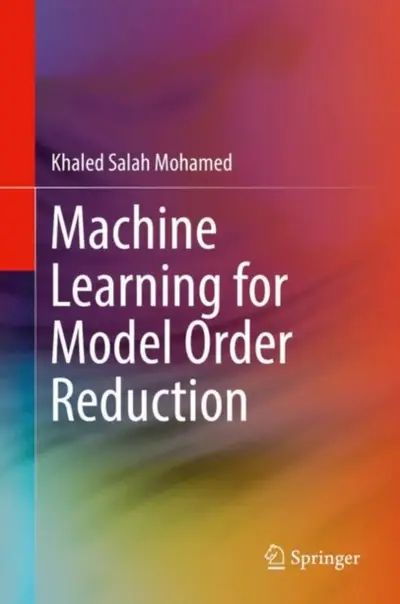
Machine Learning for Model Order Reduction
Price and availability
$148.99
Available in: Andorra, Austria, Australia, Belgium, Bulgaria, Canada, Switzerland, Cyprus, Czechia, Germany, Denmark, Estonia, Spain, Finland, France, United Kingdom, Guernsey, Greece, Croatia, Hungary, Ireland, Isle of Man, Iceland, Italy, Jersey, Japan, Liechtenstein, Lithuania, Luxembourg, Latvia, Monaco, Malta, Netherlands, Norway, Poland, Portugal, Romania, Sweden, Slovenia, Slovakia, San Marino, United States, Vatican City, South Africa
Stores: US, UK, Canada, EU, Australia.
Sign in to buyThe price is re-checked by the server before payment.
For personal use under the eBook licence.
- Format
- EPUB
- DRM
- Not stated by the publisher
- Language
- English
- Publisher
- Springer International Publishing
- Published
- 2 March 2018
- ISBN
- 9783319757148
- Subjects
- Electronics engineering, Circuits & components, Computer architecture & logic design, Machine learning, Electronics engineering, Electronics: circuits and components, Computer architecture and logic design
About this book
This Book discusses machine learning for model order reduction, which can be used in modern VLSI design to predict the behavior of an electronic circuit, via mathematical models that predict behavior. The author describes techniques to reduce significantly the time required for simulations involving large-scale ordinary differential equations, which sometimes take several days or even weeks. This method is called model order reduction (MOR), which reduces the complexity of the original large system and generates a reduced-order model (ROM) to represent the original one. Readers will gain in-depth knowledge of machine learning and model order reduction concepts, the tradeoffs involved with using various algorithms, and how to apply the techniques presented to circuit simulations and numerical analysis.Introduces machine learning algorithms at the architecture level and the algorithm levels of abstraction;Describes new, hybrid solutions for model order reduction;Presents machine learning algorithms in depth, but simply;Uses real, industrial applications to verify algorithms.
Bibliographic data © Gardners Books Ltd.