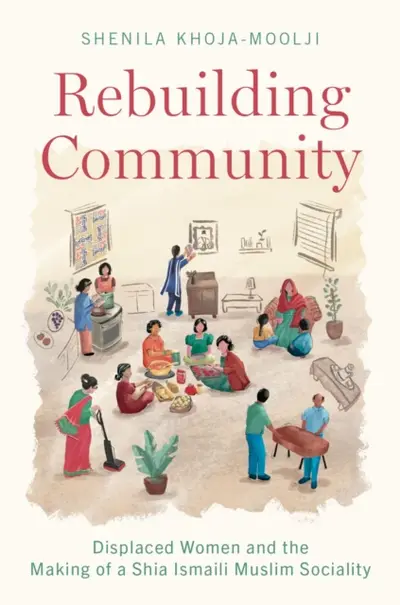
EPUB · English
Rebuilding Community
Displaced Women and the Making of a Shia Ismaili Muslim Sociality
Price and availability
$20.99
Available in: Andorra, Austria, Australia, Belgium, Bulgaria, Canada, Switzerland, Cyprus, Czechia, Germany, Denmark, Estonia, Spain, Finland, France, United Kingdom, Guernsey, Greece, Croatia, Hungary, Ireland, Isle of Man, Iceland, Italy, Jersey, Japan, Liechtenstein, Lithuania, Luxembourg, Latvia, Monaco, Malta, Netherlands, Norway, Poland, Portugal, Romania, Sweden, Slovenia, Slovakia, San Marino, United States, Vatican City, South Africa
Stores: US, UK, Canada, EU, Australia.
Sign in to buyThe price is re-checked by the server before payment.
For personal use under the eBook licence.
- Format
- EPUB
- DRM
- Not stated by the publisher
- Language
- English
- Publisher
- Oxford University Press
- Published
- 4 July 2023
- ISBN
- 9780197642054
- Subjects
- Islam, Migration, immigration & emigration, Gender studies: women, Ethnic minorities & multicultural studies, Islamic studies, JBFH, JBSF1, JBSL1, JBSR, QRP
About this book
Over the course of the twentieth century, Shia Ismaili Muslim communities were repeatedly displaced. How, in the aftermath of these displacements, did they remake their communities? Shenila Khoja-Moolji highlights women's critical role in this rebuilding process and breaks new ground by writing women into modern Ismaili history. Rebuilding Community tells the story of how Ismaili Muslim women who fled East Pakistan and East Africa in the 1970s recreated religious community (jamat) in North America. Drawing on oral histories, fieldwork, and memory texts, Khoja-Moolji illuminates the placemaking activities through which Ismaili women reproduce bonds of spiritual kinship: from cooking for congregants on feast days and looking after sick coreligionists to engaging in memory work through miracle stories and cookbooks. Khoja-Moolji situates these activities within the framework of ethical norms that more broadly define and sustain the Ismaili sociality. Jamat--and religious community more generally--is not a given, but an ethical relation that is maintained daily and intergenerationally through everyday acts of care. By emphasizing women's care work in producing relationality and repairing trauma, Khoja-Moolji disrupts the conventional articulation of displaced people as dependent subjects.
Bibliographic data © Gardners Books Ltd.