PDF · English
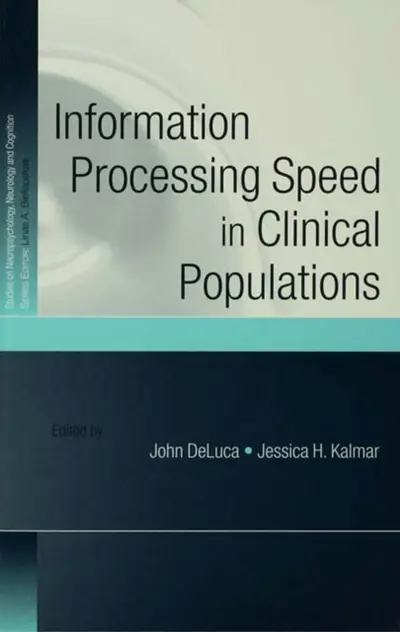
Information Processing Speed in Clinical Populations
Price and availability
$83.99
Available in: Andorra, Austria, Australia, Belgium, Bulgaria, Canada, Switzerland, Cyprus, Czechia, Germany, Denmark, Estonia, Spain, Finland, France, United Kingdom, Guernsey, Greece, Croatia, Hungary, Ireland, Isle of Man, Iceland, Italy, Jersey, Japan, Liechtenstein, Lithuania, Luxembourg, Latvia, Monaco, Malta, Netherlands, Norway, Poland, Portugal, Romania, Sweden, Slovenia, Slovakia, San Marino, United States, Vatican City, South Africa
Stores: US, UK, Canada, EU, Australia.
Sign in to buyThe price is re-checked by the server before payment.
For personal use under the eBook licence.
- Format
- DRM
- Not stated by the publisher
- Language
- English
- Publisher
- Taylor & Francis
- Published
- 13 May 2013
- ISBN
- 9781134954667
- Subjects
- Psychology, Physiological & neuro-psychology, biopsychology, Cognition & cognitive psychology, Clinical psychology, Physiological psychology, neuropsychology, biopsychology, Cognition and cognitive psychology, Rehabilitation
About this book
Although investigated for over 100 years, it is only now that we are beginning to understand how speed of information processing is affected in various clinical populations. Processing speed has a major impact on higher level cognitive abilities and is extremely vulnerable to neurological insult and the aging process. The importance of processing speed with respect to brain function, cognition and overall quality of life is now the focus of a new and exciting body of research in clinical populations.This book provides a scholarly and clinically sensitive review of research on processing speed and its issues in clinical populations. Readers will come away with an in-depth understanding of human information processing speed including its historical development, its relationship to other cognitive functions, the developmental course of the ability across the lifespan, and its impact on everyday life in various clinical populations. Other highlights of the text are its discussion of the speed vs. accuracy trade-off, tools available for measuring processing speed, the unfolding research on genetic contributions to processing speed, and the latest ideas in rehabilitation.With contributing authors who are experts in their fields, Information Processing Speed in Clinical Populations represents a valuable resource for researchers, scholars, and clinicians by providing a concise summary of the existing research on processing speed across an array of disciplines and populations.
Bibliographic data © Gardners Books Ltd.