PDF · root
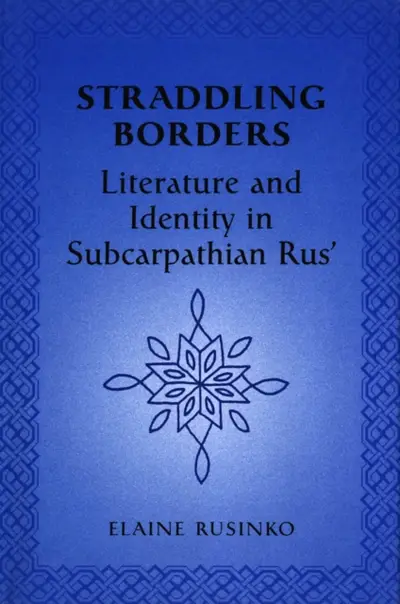
Straddling Borders
Literature and Identity in Subcarpathian Rus''
Price and availability
$193.99
Available in: Andorra, Austria, Australia, Belgium, Bulgaria, Canada, Switzerland, Cyprus, Czechia, Germany, Denmark, Estonia, Spain, Finland, France, United Kingdom, Guernsey, Greece, Croatia, Hungary, Ireland, Isle of Man, Iceland, Italy, Jersey, Japan, Liechtenstein, Lithuania, Luxembourg, Latvia, Monaco, Malta, Netherlands, Norway, Poland, Portugal, Romania, Sweden, Slovenia, Slovakia, San Marino, United States, Vatican City, South Africa
Stores: US, UK, Canada, EU, Australia.
Sign in to buyThe price is re-checked by the server before payment.
For personal use under the eBook licence.
- Format
- DRM
- Not stated by the publisher
- Language
- root
- Publisher
- University of Toronto Press
- Published
- 25 April 2003
- Pages
- 576
- ISBN
- 9781442680227
- Subjects
- Eastern Europe, Slavic (Slavonic) languages, Literary studies: general, Slavic (Slavonic) languages, Literary studies: general
About this book
The Subcarpathian Rusyns are an east Slavic people who live along the southern slopes of the Carpathian mountains where the borders of Ukraine, Slovakia, and Poland meet. Through centuries of oppression under the Austro-Hungarian and Soviet empires, they have struggled to preserve their culture and identity. Rusyn literature, reflecting various national influences and written in several linguistic variants, has historically been a response to social conditions, an affirmation of identity, and a strategy to ensure national survival. In this first English-language study of Rusyn literature, Elaine Rusinko looks at the literary history of Subcarpathia from the perspective of cultural studies and postcolonial theory, presenting Rusyn literature as a process of continual negotiation among states, religions, and languages, resulting in a characteristic hybridity that has made it difficult to classify Rusyn literature in traditional literary scholarship. Rusinko traces Rusyn literature from its emergence in the sixteenth century, through the national awakening of the mid-nineteenth century and its struggle for survival under Hungarian oppression, to its renaissance in inter-war Czechoslovakia. She argues that Rusyn literature provides an acute illustration of the constructedness of national identity, and has prefigured international postmodern culture with its emphasis on border-crossings, intersecting influences, and liminal spaces. With extracts from Rusyn texts never before available in English, Rusinko's study creates an entirely new perspective on Rusyn literature that rescues it from the clichés of Soviet dominated critical theory and makes an important contribution to Slavic studies in particular and post-colonial critical studies in general.
Bibliographic data © Gardners Books Ltd.