PDF · English
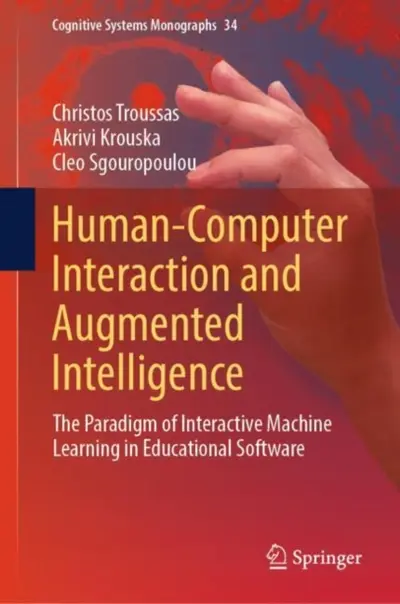
Human-Computer Interaction and Augmented Intelligence
The Paradigm of Interactive Machine Learning in Educational Software
Price and availability
$175.99
Available in: Andorra, Austria, Australia, Belgium, Bulgaria, Canada, Switzerland, Cyprus, Czechia, Germany, Denmark, Estonia, Spain, Finland, France, United Kingdom, Guernsey, Greece, Croatia, Hungary, Ireland, Isle of Man, Iceland, Italy, Jersey, Japan, Liechtenstein, Lithuania, Luxembourg, Latvia, Monaco, Malta, Netherlands, Norway, Poland, Portugal, Romania, Sweden, Slovenia, Slovakia, San Marino, United States, Vatican City, South Africa
Stores: US, UK, Canada, EU, Australia.
Sign in to buyThe price is re-checked by the server before payment.
For personal use under the eBook licence.
- Format
- DRM
- Not stated by the publisher
- Language
- English
- Publisher
- Springer Nature Switzerland
- Published
- 13 March 2025
- ISBN
- 9783031844539
- Subjects
- Educational equipment & technology, computer-aided learning (CAL), Probability & statistics, Engineering: general, Artificial intelligence, Machine learning, Educational equipment and technology, computer-aided learning (CAL), Artificial intelligence (AI), Machine learning
About this book
This book explores the transformative roles of human-computer interaction (HCI) and augmented intelligence (AI) in shaping intelligent systems. HCI focuses on designing interactive systems that enhance human-technology relationships, while AI empowers users with adaptive, data-driven tools that complement decision-making. Together, these fields drive innovation, creating systems that are efficient, intuitive, and inclusive, addressing diverse user needs across various domains.Central to this work is the paradigm of interactive machine learning (IML), which builds on HCI and AI principles to create adaptive systems capable of evolving in real-time. The book highlights the application of IML in educational software, demonstrating how dynamic, personalized, and responsive learning environments can enhance student engagement and success. It provides detailed case studies and practical examples that showcase how IML aligns educational content, feedback, and interactions with learner behaviors and preferences. Additionally, it includes numerous Python code implementations and actionable design strategies, making these concepts accessible to practitioners and researchers alike.Key topics include leveraging cognitive and communication styles to shape adaptive systems, integrating learning models to enhance personalization, and addressing ethical considerations such as data privacy and algorithmic fairness. Readers will also discover discussions on creating personalized tutoring systems, collaborative platforms, and immersive environments that redefine educational technology.This book is a valuable resource for researchers, software developers, educators, instructional designers, and technologists at the intersection of human-computer interaction, augmented intelligence, and educational innovation. With its comprehensive framework and practical insights, it offers the tools to design adaptive, inclusive, and impactful learning systems for the future.
Bibliographic data © Gardners Books Ltd.