PDF · English
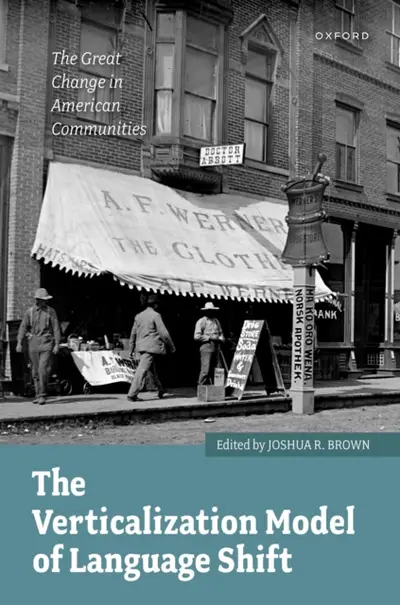
Verticalization Model of Language Shift
The Great Change in American Communities
Price and availability
$87.99
Available in: Andorra, Austria, Australia, Belgium, Bulgaria, Canada, Switzerland, Cyprus, Czechia, Germany, Denmark, Estonia, Spain, Finland, France, United Kingdom, Guernsey, Greece, Croatia, Hungary, Ireland, Isle of Man, Iceland, Italy, Jersey, Japan, Liechtenstein, Lithuania, Luxembourg, Latvia, Monaco, Malta, Netherlands, Norway, Poland, Portugal, Romania, Sweden, Slovenia, Slovakia, San Marino, United States, Vatican City, South Africa
Stores: US, UK, Canada, EU, Australia.
Sign in to buyThe price is re-checked by the server before payment.
For personal use under the eBook licence.
- Format
- DRM
- Not stated by the publisher
- Language
- English
- Publisher
- Oxford University Press
- Published
- 15 August 2022
- ISBN
- 9780192633583
- Subjects
- USA, Sociolinguistics, Historical & comparative linguistics, History of the Americas, Social & cultural history, Ethnic minorities & multicultural studies, Sociolinguistics, Historical and comparative linguistics, History of the Americas, Social and cultural history
About this book
This book introduces a new and still emerging theoretical framework for understanding language shift and uses this approach to explore a range of minority language communities in the United States. To date, approaches to language shift have typically relied on explaining the process through descriptive sociolinguistic models, i.e., how the community first becomes bilingual in both the majority and minority languages and then eventually shifts entirely to the majority language. The contributions in this volume instead attribute shift to a change from local control of tightly interconnected 'horizontal' institutions within a community to more external or 'vertical' control of those increasingly autonomous institutions outside the community; in short, language shift is driven by specific changes in community structure. In addition, unlike previous approaches to language shift, the one proposed here is generalizable. Following an introduction to the theory, the main five chapters in the book offer case studies of individual language communities, in different contexts and different periods. The final three chapters of the book take a broader perspective, looking beyond the United States: two leading specialists in the field provide critical commentaries on the theoretical approach and offer refinements to a theory of language shift, before a concluding chapter draws together the findings of the case studies and reflections on the commentaries. The volume will appeal to researchers and students in the fields of language revitalization, community studies, sociolinguistics, and social history.
Bibliographic data © Gardners Books Ltd.