PDF · English
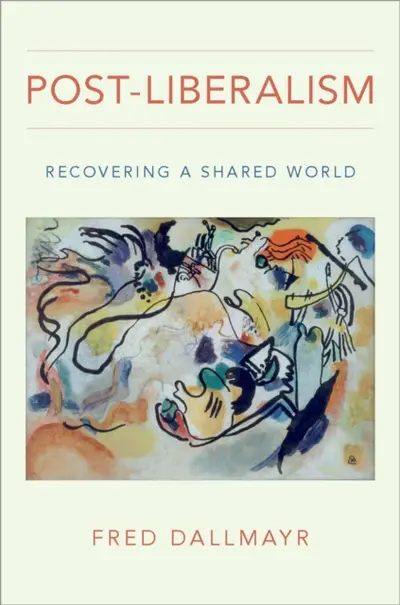
Post-Liberalism
Recovering a Shared World
Price and availability
$52.99
Available in: Andorra, Austria, Australia, Belgium, Bulgaria, Canada, Switzerland, Cyprus, Czechia, Germany, Denmark, Estonia, Spain, Finland, France, United Kingdom, Guernsey, Greece, Croatia, Hungary, Ireland, Isle of Man, Iceland, Italy, Jersey, Japan, Liechtenstein, Lithuania, Luxembourg, Latvia, Monaco, Malta, Netherlands, Norway, Poland, Portugal, Romania, Sweden, Slovenia, Slovakia, San Marino, United States, Vatican City, South Africa
Stores: US, UK, Canada, EU, Australia.
Sign in to buyThe price is re-checked by the server before payment.
For personal use under the eBook licence.
- Format
- DRM
- Not stated by the publisher
- Language
- English
- Publisher
- Oxford University Press
- Published
- 11 April 2019
- ISBN
- 9780190949914
- Subjects
- Philosophy, Social & political philosophy, Political science & theory, Political science and theory, QD, QDTS
About this book
Liberal democracy is the dominant political ideology in the West today. Taken at face value it suggests an equivalency between its two central components--liberalism and democracy--but as Fred Dallmayr argues here, the two operate in very different registers. The two frequently conflict, endangering our public life.This is evident in the rise of self-centered neo-liberalism as well as autocratic movements in our world today. More specifically, the conflict within liberal democracy is between the pursuit of individual or coporate interest, on the one hand, and a "e;people"e; increasingly fractured by economic and cultural clashes, on the other. Dallmayr asks whether there is still room for genuine privacy and authentic democracy when all public goods, from schools to parks, police, and armies, have been made the target of privatization. In this book, Dallmayr sets out to rescue democracy as a shared public and post-liberal regime. Nonetheless, "e;post-liberalism"e; does not involve the denial of human freedom nor does it suggest the endorsement of illiberal collectivism or nationalism. Drawing on a wide range of contemporary political, religious, and secular thought, Dallmayr charts a possible path to a liberal socialism that is devoid of egalitarian imperatives and a private sphere free from acquisitiveness.
Bibliographic data © Gardners Books Ltd.