EPUB · English
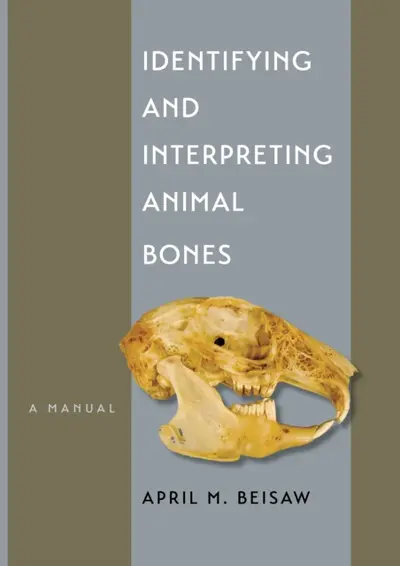
Identifying and Interpreting Animal Bones
A Manual
Price and availability
$31.99
Available in: Andorra, Austria, Australia, Belgium, Bulgaria, Canada, Switzerland, Cyprus, Czechia, Germany, Denmark, Estonia, Spain, Finland, France, United Kingdom, Guernsey, Greece, Croatia, Hungary, Ireland, Isle of Man, Iceland, Italy, Jersey, Japan, Liechtenstein, Lithuania, Luxembourg, Latvia, Monaco, Malta, Netherlands, Norway, Poland, Portugal, Romania, Sweden, Slovenia, Slovakia, San Marino, United States, Vatican City, South Africa
Stores: US, UK, Canada, EU, Australia.
Sign in to buyThe price is re-checked by the server before payment.
For personal use under the eBook licence.
- Format
- EPUB
- DRM
- Not stated by the publisher
- Language
- English
- Publisher
- Texas A&M University Press
- Published
- 16 October 2013
- ISBN
- 9781623490829
- Subjects
- Archaeology, Archaeological science, methodology & techniques, Physical anthropology, Zoology & animal sciences, JHM, NK, NKX, Zoology and animal sciences
About this book
Offering a field-tested analytic method for identifying faunal remains, along with helpful references, images, and examples of the most commonly encountered North American species, Identifying and Interpreting Animal Bones: A Manual provides an important new reference for students, avocational archaeologists, and even naturalists and wildlife enthusiasts. Using the basic principles outlined here, the bones of any vertebrate animal, including humans, can be identified and their relevance to common research questions can be better understood. Because the interpretation of archaeological sites depends heavily on the analysis of surrounding materialssoils, artifacts, and floral and faunal remainsit is important that non-human remains be correctly distinguished from human bones, that distinctions between domesticated and wild or feral animals be made correctly, and that evidence of the reasons for faunal remains in the site be recognized. But the ability to identify and analyze animal bones is a skill that is not easy to learn from a traditional textbook. In Identifying and Interpreting Animal Bones, veteran archaeologist and educator April Beisaw guides readers through the stages of identification and analysis with sample images and data, also illustrating how specialists make analytical decisions that allow for the identification of the smallest fragments of bone. Extensive additional illustrative material, from the author's own collected assemblages and from those in the Archaeological Analytical Research Facility at Binghamton University in New York, are also available in the book's online supplement. There, readers can view and interact with images to further understanding of the principles explained in the text.
Bibliographic data © Gardners Books Ltd.