PDF · English
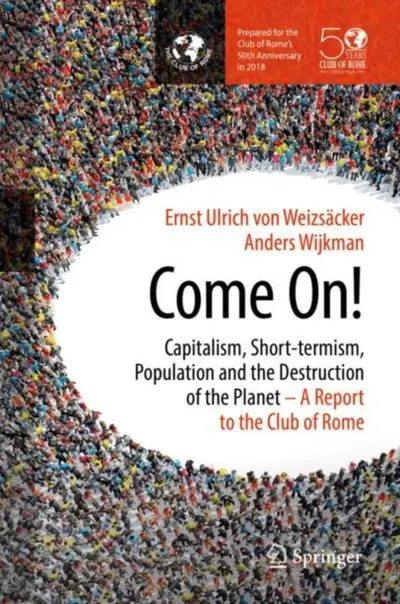
Come On!
Capitalism, Short-termism, Population and the Destruction of the Planet
Price and availability
$33.99
Available in: Andorra, Austria, Australia, Belgium, Bulgaria, Canada, Switzerland, Cyprus, Czechia, Germany, Denmark, Estonia, Spain, Finland, France, United Kingdom, Guernsey, Greece, Croatia, Hungary, Ireland, Isle of Man, Iceland, Italy, Jersey, Japan, Liechtenstein, Lithuania, Luxembourg, Latvia, Monaco, Malta, Netherlands, Norway, Poland, Portugal, Romania, Sweden, Slovenia, Slovakia, San Marino, United States, Vatican City, South Africa
Stores: US, UK, Canada, EU, Australia.
Sign in to buyThe price is re-checked by the server before payment.
For personal use under the eBook licence.
- Format
- DRM
- Not stated by the publisher
- Language
- English
- Publisher
- Springer New York
- Published
- 12 November 2017
- ISBN
- 9781493974191
- Subjects
- Energy industries & utilities, Geography, Physical geography & topography, The environment, Environmental management, Sustainability, Environmental science, engineering & technology, Physical geography and topography, The environment, Environmental management, Sustainability
About this book
Current worldwide trends are not sustainable. The Club of Rome's warnings published in the book Limits to Growth are still valid. Remedies that are acceptable for the great majority tend to make things worse. We seem to be in a philosophical crisis. Pope Francis says it clearly: our common home is in deadly danger. Analyzing the philosophical crisis, the book comes to the conclusion that the world may need a "e;new enlightenment"e;; one that is not based solely on doctrine, but instead addresses a balance between humans and nature, as well as a balance between markets and the state, and the short versus long term. To do this we need to leave behind working in "e;silos"e; in favor of a more systemic approach that will require us to rethink the organization of science and education.However, we have to act now; the world cannot wait until 7.6 billion people have struggled to reach a new enlightenment. This book is full of optimistic case studies and policy proposals that will lead us back to a trajectory of sustainability. But it is also necessary to address the taboo topic of population increase. Countries with a stable population fare immensely better than those with continued increase. Finally, we are presenting an optimistic book from the Club of Rome.
Bibliographic data © Gardners Books Ltd.