PDF · English
Fortuna
Deity and Concept in Archaic and Republican Italy
Price and availability
$100.99
Available in: Andorra, Austria, Australia, Belgium, Bulgaria, Canada, Switzerland, Cyprus, Czechia, Germany, Denmark, Estonia, Spain, Finland, France, United Kingdom, Guernsey, Greece, Croatia, Hungary, Ireland, Isle of Man, Iceland, Italy, Jersey, Japan, Liechtenstein, Lithuania, Luxembourg, Latvia, Monaco, Malta, Netherlands, Norway, Poland, Portugal, Romania, Sweden, Slovenia, Slovakia, San Marino, United States, Vatican City, South Africa
Stores: US, UK, Canada, EU, Australia.
Sign in to buyThe price is re-checked by the server before payment.
For personal use under the eBook licence.
- Format
- DRM
- Not stated by the publisher
- Language
- English
- Publisher
- Oxford University Press
- Published
- 23 February 2018
- ISBN
- 9780191090141
- Subjects
- Ancient Rome, Literary studies: classical, early & medieval, Classical history / classical civilisation, Classical Greek & Roman archaeology, History of religion, Ancient religions & mythologies, Ancient Rome, Literary studies: ancient, classical and medieval, Ancient history, Archaeology by period / region, History of religion, Ancient religions and Mythologies
About this book
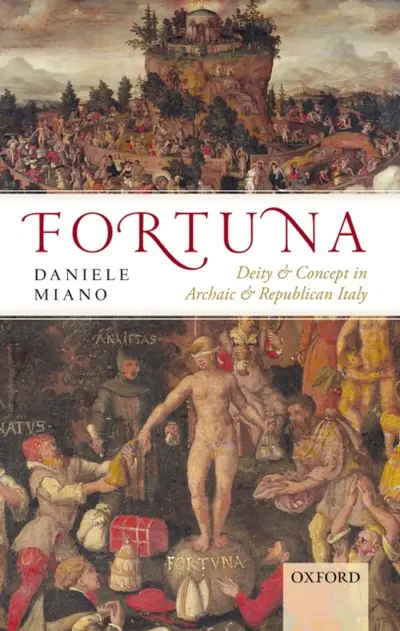
What is good luck and what did it mean to the Romans? What connections were there between luck and childbirth, victory in war, or success in business? What did Roman statesmen like Cicero and Caesar think about luck? This volume aims to address these questions by focusing on the Latin goddess Fortuna, one of the better known deities in ancient Italy. The earliest forms of her worship can be traced back to archaic Latium, and though the chronological scope of the discussion presented here covers the archaic age to the late Republic, she was still a widely recognized allegorical figure during the Middle Ages and the Renaissance. The primary reason for Fortuna's longevity is that she was a conceptual deity, symbiotically connected to the concept of chance and good fortune. When communities, individuals, and social groups interacted with the goddess, they were inevitably also interacting with the concept: renegotiating it, enriching it with new meanings, and challenging established associations. All the available literary, epigraphic, and archaeological sources on Fortuna are explored here in depth, including analyses of all the attested sanctuaries of the goddess in Italy, an updated study of inscribed gifts offered to her by a variety of individuals, and discussion of how authors such as Cicero and Caesar wrote about Fortuna, chance, and good luck. This study of the goddess based on conceptual analysis serves to construct a radically new picture of the historical development of this deity in the context of the cultural interactions taking place in ancient Italy, and also suggests a new approach to polytheism based on an exploration of the connection between gods and goddesses and concepts.
Bibliographic data © Gardners Books Ltd.