PDF · English
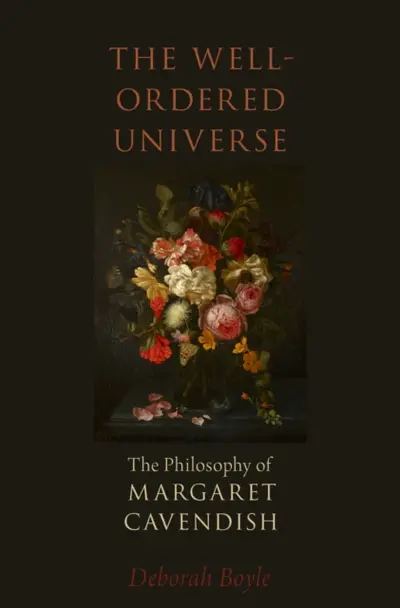
Well-Ordered Universe
The Philosophy of Margaret Cavendish
Price and availability
$93.99
Available in: Andorra, Austria, Australia, Belgium, Bulgaria, Canada, Switzerland, Cyprus, Czechia, Germany, Denmark, Estonia, Spain, Finland, France, United Kingdom, Guernsey, Greece, Croatia, Hungary, Ireland, Isle of Man, Iceland, Italy, Jersey, Japan, Liechtenstein, Lithuania, Luxembourg, Latvia, Monaco, Malta, Netherlands, Norway, Poland, Portugal, Romania, Sweden, Slovenia, Slovakia, San Marino, United States, Vatican City, South Africa
Stores: US, UK, Canada, EU, Australia.
Sign in to buyThe price is re-checked by the server before payment.
For personal use under the eBook licence.
- Format
- DRM
- Not stated by the publisher
- Language
- English
- Publisher
- Oxford University Press
- Published
- 1 November 2017
- ISBN
- 9780190234812
- Subjects
- Philosophy, Philosophy: metaphysics & ontology, History of ideas, Impact of science & technology on society, JBCC9, Impact of science and technology on society, QD, QDTJ
About this book
The prolific Margaret Cavendish (1623-1673) published books on natural philosophy as well as stories, plays, poems, orations, allegories, and letters. Her mature philosophical system offered a unique panpsychist theory of Nature as composed of a continuous, non-atomistic, perceiving, knowing matter. In contrast to the dominant philosophical thinking of her day, Cavendish argued that all matter has free will and can choose whether or not to follow Nature's rules. The Well-Ordered Universe explores the development of Cavendish's natural philosophy from the atomism of her 1653 poems to the panpsychist materialism of her 1668 Grounds of Natural Philosophy. Deborah Boyle argues that her natural philosophy, her medical theories, and her social and political philosophy are all informed by an underlying concern with order, regularity, and rule-following. This focus on order reveals interesting connections among apparently disparate elements of Cavendish's philosophical program, including her views on gender, on animals and the environment, and on sickness and health. Focusing on the role of order in Cavendish's philosophy also helps reveal key differences between her natural philosophy and her more conservative social and political philosophy. Cavendish believed that humans' special desire for public recognition often leads to an unruly ambition, causing humans to disrupt society in ways not seen in the rest of Nature. Thus, The Well-Ordered Universe defends Cavendish as a royalist who endorsed absolute monarchy and a rigid social hierarchy for maintaining order in human society.
Bibliographic data © Gardners Books Ltd.