PDF · English
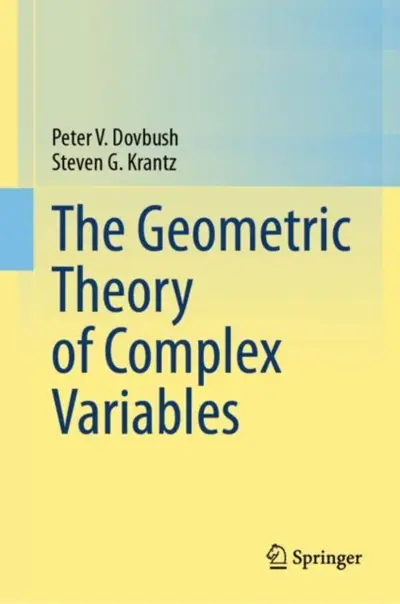
Geometric Theory of Complex Variables
Price and availability
$242.99
Available in: Andorra, Austria, Australia, Belgium, Bulgaria, Canada, Switzerland, Cyprus, Czechia, Germany, Denmark, Estonia, Spain, Finland, France, United Kingdom, Guernsey, Greece, Croatia, Hungary, Ireland, Isle of Man, Iceland, Italy, Jersey, Japan, Liechtenstein, Lithuania, Luxembourg, Latvia, Monaco, Malta, Netherlands, Norway, Poland, Portugal, Romania, Sweden, Slovenia, Slovakia, San Marino, United States, Vatican City, South Africa
Stores: US, UK, Canada, EU, Australia.
Sign in to buyThe price is re-checked by the server before payment.
For personal use under the eBook licence.
- Format
- DRM
- Not stated by the publisher
- Language
- English
- Publisher
- Springer Nature Switzerland
- Published
- 28 January 2025
- ISBN
- 9783031772047
- Subjects
- Calculus & mathematical analysis, Complex analysis, complex variables, Functional analysis & transforms, Calculus and mathematical analysis, Complex analysis, complex variables, Functional analysis and transforms
About this book
This book provides the reader with a broad introduction to the geometric methodology in complex analysis. It covers both single and several complex variables, creating a dialogue between the two viewpoints.Regarded as one of the 'grand old ladies' of modern mathematics, complex analysis traces its roots back 500 years. The subject began to flourish with Carl Friedrich Gauss's thesis around 1800. The geometric aspects of the theory can be traced back to the Riemann mapping theorem around 1850, with a significant milestone achieved in 1938 with Lars Ahlfors's geometrization of complex analysis. These ideas inspired many other mathematicians to adopt this perspective, leading to the proliferation of geometric theory of complex variables in various directions, including Riemann surfaces, Teichmuller theory, complex manifolds, extremal problems, and many others.This book explores all these areas, with classical geometric function theory as its main focus. Its accessible and gentle approach makes it suitable for advanced undergraduate and graduate students seeking to understand the connections among topics usually scattered across numerous textbooks, as well as experienced mathematicians with an interest in this rich field.
Bibliographic data © Gardners Books Ltd.