PDF · English
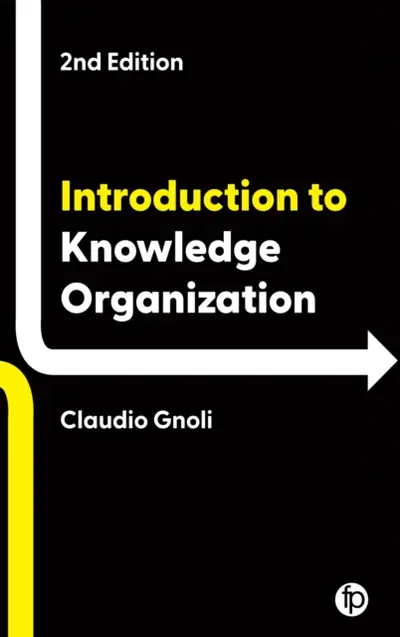
Introduction to Knowledge Organization
Price and availability
$59.99
Not available to buy yet.
Available in: Andorra, Austria, Australia, Belgium, Bulgaria, Canada, Switzerland, Cyprus, Czechia, Germany, Denmark, Estonia, Spain, Finland, France, United Kingdom, Guernsey, Greece, Croatia, Hungary, Ireland, Isle of Man, Iceland, Italy, Jersey, Japan, Liechtenstein, Lithuania, Luxembourg, Latvia, Monaco, Malta, Netherlands, Norway, Poland, Portugal, Romania, Sweden, Slovenia, Slovakia, San Marino, United States, Vatican City, South Africa
Stores: US, UK, Canada, EU, Australia.
This title cannot be bought in this store yet: its supplier terms, territorial rights or price are still being confirmed.
For personal use under the eBook licence.
- Format
- DRM
- Not stated by the publisher
- Language
- English
- Publisher
- Facet Publishing
- Published
- 15 October 2026
- ISBN
- 9781783307975
- Subjects
- Library & information sciences, Library, archive & information management, Library & information services, Library and information sciences / Museology, Library, archive and information management
About this book
'A mighty introduction to knowledge organization' - Technical Services QuarterlyFully revised and updated throughout, the new edition of this book provides a complete introduction to the rapidly expanding field of Knowledge Organization (KO), presenting historical precedents and theoretical foundations in a discursive, intelligible form, covering the philosophical, linguistic and technical aspects.In the contemporary context of global information exchange through linked data, knowledge organization systems (KOS) need to be represented in standard inter-operable formats. Different formats for KOS representation including MARC, Dublin Core, SKOS and OWL are introduced as well as the application of knowledge organization to a variety of activities and contexts: education, encyclopaedic knowledge, the Internet, libraries, archives, museums, galleries and other institutions collecting and providing access to recorded knowledge.Key coverage includes: ontology and epistemology in KO KO structures: lists, hierarchies, facets KO types: tagging, taxonomies, thesauri, classifications, ontologies conceptual analysis of documents applications in the digital age. Covering theoretical and practical aspects of KO and using real-life examples to illustrate its application, this comprehensive book is a valuable resource for students, researchers and practitioners of knowledge organization, information organization, cataloguing and classification.
Bibliographic data © Gardners Books Ltd.