EPUB · English
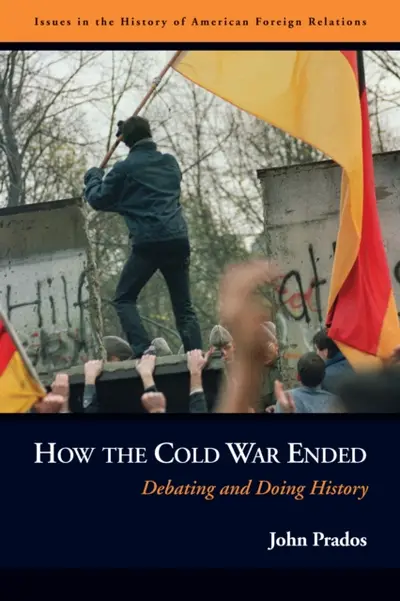
How the Cold War Ended
Debating and Doing History
Price and availability
Not sold in this region
Available in: Andorra, Austria, Australia, Belgium, Bulgaria, Switzerland, Cyprus, Czechia, Germany, Denmark, Estonia, Spain, Finland, France, United Kingdom, Guernsey, Greece, Croatia, Hungary, Ireland, Isle of Man, Iceland, Italy, Jersey, Japan, Liechtenstein, Lithuania, Luxembourg, Latvia, Monaco, Malta, Netherlands, Norway, Poland, Portugal, Romania, Sweden, Slovenia, Slovakia, San Marino, Vatican City, South Africa
Stores: UK, EU, Australia. Not available in the United States store.
This title cannot be bought in this store yet: its supplier terms, territorial rights or price are still being confirmed.
For personal use under the eBook licence.
- Format
- EPUB
- DRM
- Not stated by the publisher
- Language
- English
- Publisher
- University of Nebraska Press
- Published
- 1 October 2011
- ISBN
- 9781597976121
- Subjects
- Russia, USA, c 1945 to c 2000 (Post-war period), History: theory & methods, European history, History of the Americas, The Cold War, International relations, Russia, United States of America, USA, USSR, Soviet Union, International relations, European history, History of the Americas
About this book
The Cold War continues to shape international relations almost twenty years after being acknowledged as the central event of the last half of the twentieth century. Interpretations of how it ended thus remain crucial to an accurate understanding of global events and foreign policy. The reasons for the Cold War's conclusion, and the timing of its ending, are disputed to this day. In this concise introduction to the Cold War and its enduring legacy, John Prados recognizes the debate between those who argue the United States was the key player in bringing it to a close and those who maintain that American actions were secondary factors. Like a crime scene investigator meticulously dissecting evidence, he applies a succession of different methods of historical analysis to illuminate the key cataclysmic events of the 1980s and early 1990s from a range of perspectives. He also incorporates evidence from European and Soviet intelligence sources into the study. The result is a stunning narrative that redefines the era, embraces debate, and deconstructs history, providing a coherent explanation for the upheavals that ended the conflict. How the Cold War Ended also provides an in-depth guide to conducting historical inquiries: how to choose a subject, how to frame a narrative, and how to conduct research and draw conclusions. Prados does this for a variety of methods of historical analysis, furnishing a how-to guide for "e;doing history"e; even as it explores a crucial case study.
Bibliographic data © Gardners Books Ltd.