EPUB · English
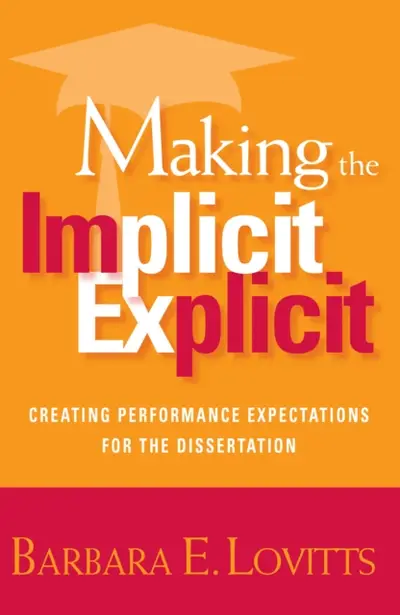
Making the Implicit Explicit
Creating Performance Expectations for the Dissertation
Price and availability
$39.99
Available in: Andorra, Austria, Australia, Belgium, Bulgaria, Canada, Switzerland, Cyprus, Czechia, Germany, Denmark, Estonia, Spain, Finland, France, United Kingdom, Guernsey, Greece, Croatia, Hungary, Ireland, Isle of Man, Iceland, Italy, Jersey, Japan, Liechtenstein, Lithuania, Luxembourg, Latvia, Monaco, Malta, Netherlands, Norway, Poland, Portugal, Romania, Sweden, Slovenia, Slovakia, San Marino, United States, Vatican City, South Africa
Stores: US, UK, Canada, EU, Australia.
Sign in to buyThe price is re-checked by the server before payment.
For personal use under the eBook licence.
- Format
- EPUB
- DRM
- Not stated by the publisher
- Language
- English
- Publisher
- Taylor & Francis
- Published
- 3 July 2023
- ISBN
- 9781000977349
- Subjects
- Higher & further education, tertiary education, Study & learning skills: general, Education: examinations and assessment, Educational strategies and policy, Higher education, tertiary education
About this book
Despite their and other stakeholders' consistent demand for excellence, doctoral programs have rarely, if ever, been assessed in terms of the quality of the dissertations departments produce. Yet dissertations provide the most powerful, objective measure of the success of a department's doctoral program. Indeed, assessment, when done properly, can help departments achieve excellence by providing insight into a program's strengths and weaknesses.This book and the groundbreaking study on which it is based is about making explicit to doctoral students the tacit "e;rules"e; for the assessment of the final of all final educational products-the dissertation. The purpose of defining performance expectations is to make them more transparent to graduate students while they are in the researching and writing phases, and thus to help them achieve to higher levels of accomplishment. Lovitts proposes the use of rubrics to clarify performance expectations-not to rate dissertations or individual components of dissertations to provide a summary score, but to facilitate formative assessment to support, not substitute for, the advising process. She provides the results of a study in which over 270 faculty from ten major disciplines-spanning the sciences, social sciences, and humanities-were asked to make explicit their implicit standards or criteria for evaluating dissertations. The book concludes with a summary of the practical and research implications for different stakeholders: faculty, departments, universities, disciplinary associations, accrediting organizations, and doctoral students themselves.The methods described can easily be adapted for the formative assessment of capstone courses, senior and master's theses, comprehensive exams, papers, and journal articles.
Bibliographic data © Gardners Books Ltd.