EPUB · English
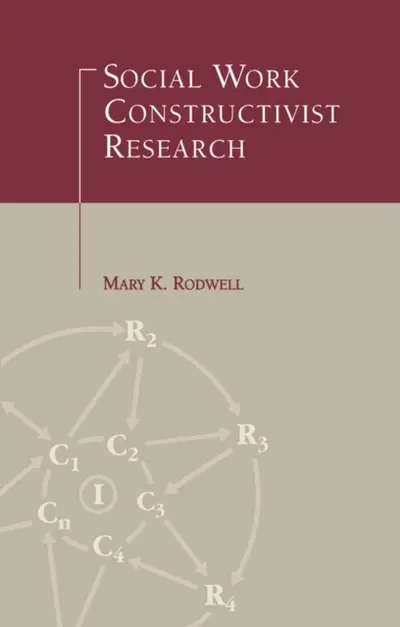
Social Work Constructivist Research
Price and availability
$74.99
Available in: Andorra, Austria, Australia, Belgium, Bulgaria, Canada, Switzerland, Cyprus, Czechia, Germany, Denmark, Estonia, Spain, Finland, France, United Kingdom, Guernsey, Greece, Croatia, Hungary, Ireland, Isle of Man, Iceland, Italy, Jersey, Japan, Liechtenstein, Lithuania, Luxembourg, Latvia, Monaco, Malta, Netherlands, Norway, Poland, Portugal, Romania, Sweden, Slovenia, Slovakia, San Marino, United States, Vatican City, South Africa
Stores: US, UK, Canada, EU, Australia.
Sign in to buyThe price is re-checked by the server before payment.
For personal use under the eBook licence.
- Format
- EPUB
- DRM
- Not stated by the publisher
- Language
- English
- Publisher
- Taylor & Francis
- Published
- 22 December 2015
- ISBN
- 9781134823970
- Subjects
- Sociology, Social research & statistics, Social work, Research methods / methodology, Social work
About this book
This is the first textbook to offer a clear, concise articulation of the dimensions of constructivism relevant to social work practice and research. Professor Rodwell recognizes the need to systematize a process of knowledge building and presents specific techniques to accomplish that while maintaining an interpretative stance with the focus on meaning. Social work students will see that their basic way of engaging clients in an assessment and problem-solving process is very much in keeping with constructivist research practice. In addition to delineating the philosophical assumptions of constructivism, this very practical text is geared to classroom use, with chapters on research design, rigor, data collection, data analysis, research oversight, and presentation of results. Social Work Constructivist Research is divided into four sections that, together, should give the reader the intellectual and practical background necessary to understand and undertake rigorous constructivist inquiry. The structure of this textbook is intended to provide the reader with sufficient information to competently confront all the design, implementation, and reporting elements of a constructivist inquiry process. At the completion of all sections, readers will know how the assumptions of constructivism differ from mainstream research primarily characterized by positivism or post-positivism. Readers will know how rigor expectations for research methods derived from different assumptions also differ. They will know how to: determine the feasibility of undertaking a constructivist inquiry, when, and where it is possible; manage an emergent design; and establish the trustworthiness and authenticity dimensions of a rigorous research effort. For those interested in constructivist research and its relevancy to social work, this book will prove to be a necessary resource.
Bibliographic data © Gardners Books Ltd.