PDF · English
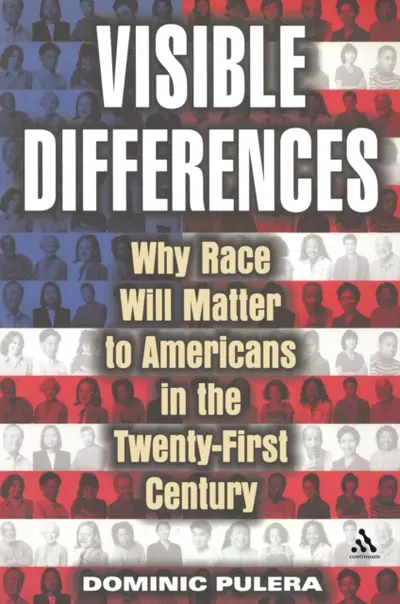
Visible Differences
Why Race Will Matter to Americans in the Twenty-First Century
Price and availability
$103.99
Available in: Andorra, Austria, Australia, Belgium, Bulgaria, Canada, Switzerland, Cyprus, Czechia, Germany, Denmark, Estonia, Spain, Finland, France, United Kingdom, Guernsey, Greece, Croatia, Hungary, Ireland, Isle of Man, Iceland, Italy, Jersey, Japan, Liechtenstein, Lithuania, Luxembourg, Latvia, Monaco, Malta, Netherlands, Norway, Poland, Portugal, Romania, Sweden, Slovenia, Slovakia, San Marino, United States, Vatican City, South Africa
Stores: US, UK, Canada, EU, Australia.
Sign in to buyThe price is re-checked by the server before payment.
For personal use under the eBook licence.
- Format
- DRM
- Not stated by the publisher
- Language
- English
- Publisher
- Bloomsbury Publishing (USA)
- Published
- 5 June 2002
- Pages
- 416
- ISBN
- 9781441170897
- Subjects
- USA, Philosophy, Ethnic minorities & multicultural studies, United States of America, USA, JBSL1, QD
About this book
Race. The mere mention of the R-word is a surefire conversation-stopper. In this book about America s most divisive social issue, Dominic J. Pulera offers a compelling roadmap to our future. This accessible and penetrating analysis is the first to include detailed coverage of America s five "e;racial"e; groups: whites, blacks, Hispanics, Asian Americans, and Native Americans. The author contends that race will matter to Americans during the twenty-first century because of visible differences, and that differences in physical appearance separating the races are the single most important factor shaping intergroup relations, in conjunction with the social, cultural, economic, and political ramifications that accompany them. Pulera shows how, why, when, and where race matters in the United States and who is affected by it. He explains the ongoing demographic transition of America from a predominantly white country to one where nonwhites are increasingly numerous and consequently more visible. The advent of a multiracial consciousness has tremendous implications for America s future, because the racial significance of almost every part of the American experience is increasing as a result. The author concludes on a note of cautious optimism as he explores whether the visible differences dividing Americans are reconcilable.
Bibliographic data © Gardners Books Ltd.