PDF · English
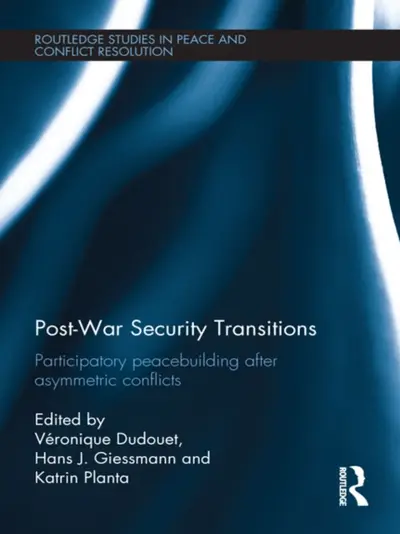
Post-War Security Transitions
Participatory Peacebuilding after Asymmetric Conflicts
Price and availability
Not sold in this region
Available in: Andorra, Austria, Australia, Belgium, Bulgaria, Switzerland, Cyprus, Czechia, Germany, Denmark, Estonia, Spain, Finland, France, United Kingdom, Guernsey, Greece, Croatia, Hungary, Ireland, Isle of Man, Iceland, Italy, Jersey, Japan, Liechtenstein, Lithuania, Luxembourg, Latvia, Monaco, Malta, Netherlands, Norway, Poland, Portugal, Romania, Sweden, Slovenia, Slovakia, San Marino, Vatican City, South Africa
Stores: UK, EU, Australia. Not available in the United States store.
This title cannot be bought in this store yet: its supplier terms, territorial rights or price are still being confirmed.
For personal use under the eBook licence.
- Format
- DRM
- Not stated by the publisher
- Language
- English
- Publisher
- Taylor & Francis
- Published
- 27 January 2012
- ISBN
- 9781136462726
- Subjects
- Peace studies & conflict resolution, Military history, International relations, Human rights, World, Peace studies and conflict resolution, International relations, Military forces and sectors
About this book
This book explores the conditions under which non-state armed groups (NSAGs) participate in post-war security and political governance. The text offers a comprehensive approach to post-war security transition processes based on five years of participatory research with local experts and representatives of former non-state armed groups. It analyses the successes and limits of peace negotiations, demobilisation, arms management, political or security sector integration, socio-economic reintegration and state reform from the direct point of view of conflict stakeholders who have been central participants in ongoing and past peacebuilding processes.Challenging common perceptions of ex-combatants as "e;spoilers"e; or "e;passive recipients of aid"e;, the various contributors examine the post-war transitions of these individuals from state challengers to peacebuilding agents. The book concludes on a cross-country comparative analysis of the main research findings and the ways in which they may facilitate a participatory, inclusive and gender-sensitive peacebuilding strategy.Post-War Security Transitions will be of much interest to students of peacebuilding, security governance, war and conflict studies, political violence and IR in general.
Bibliographic data © Gardners Books Ltd.