EPUB · English
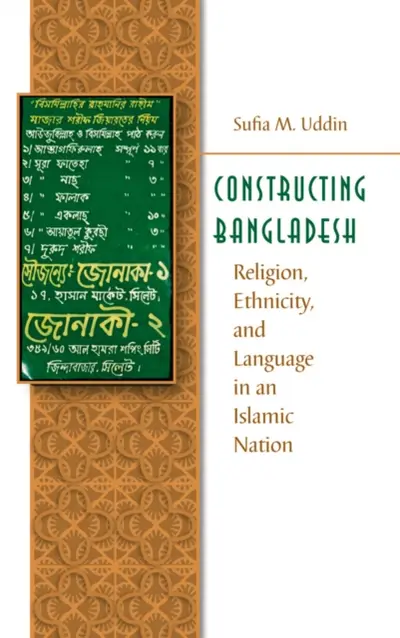
Constructing Bangladesh
Religion, Ethnicity, and Language in an Islamic Nation
Price and availability
$21.99
Available in: Andorra, Austria, Australia, Belgium, Bulgaria, Canada, Switzerland, Cyprus, Czechia, Germany, Denmark, Estonia, Spain, Finland, France, United Kingdom, Guernsey, Greece, Croatia, Hungary, Ireland, Isle of Man, Iceland, Italy, Jersey, Japan, Liechtenstein, Lithuania, Luxembourg, Latvia, Monaco, Malta, Netherlands, Norway, Poland, Portugal, Romania, Sweden, Slovenia, Slovakia, San Marino, United States, Vatican City, South Africa
Stores: US, UK, Canada, EU, Australia.
Sign in to buyThe price is re-checked by the server before payment.
For personal use under the eBook licence.
- Format
- EPUB
- DRM
- Not stated by the publisher
- Language
- English
- Publisher
- The University of North Carolina Press
- Published
- 15 December 2006
- ISBN
- 9780807877333
- Subjects
- India, Bangladesh, Asian history, Islam, Islamic studies, Political ideologies, Nationalism, South Asia (Indian sub-continent), Nationalism and nationalist ideologies and movements, Asian history, Islam
About this book
Highlighting the dynamic, pluralistic nature of Islamic civilization, Sufia M. Uddin examines the complex history of Islamic state formation in Bangladesh, formerly the eastern part of the Indian province of Bengal. Uddin focuses on significant moments in the regions history from medieval to modern times, examining the interplay of language, popular and scholarly religious literature, and the colonial experience as they contributed to the creation of a unique Bengali-Islamic identity.During the precolonial era, Bengali, the dominant regional language, infused the richly diverse traditions of the region, including Hinduism, Buddhism, and, eventually, the Islamic religion and literature brought by Urdu-speaking Muslim conquerors from North India. Islam was not simply imported into the region by the ruling elite, Uddin explains, but was incorporated into local tradition over hundreds of years of interactions between Bengalis and non-Bengali Muslims. Constantly contested and negotiated, the Bengali vision of Islamic orthodoxy and community was reflected in both language and politics, which ultimately produced a specifically Bengali-Muslim culture. Uddin argues that this process in Bangladesh is representative of what happens elsewhere in the Muslim world and is therefore an instructive example of the complex and fluid relations between local heritage and the greater Islamic global community, or umma.
Bibliographic data © Gardners Books Ltd.