EPUB · English
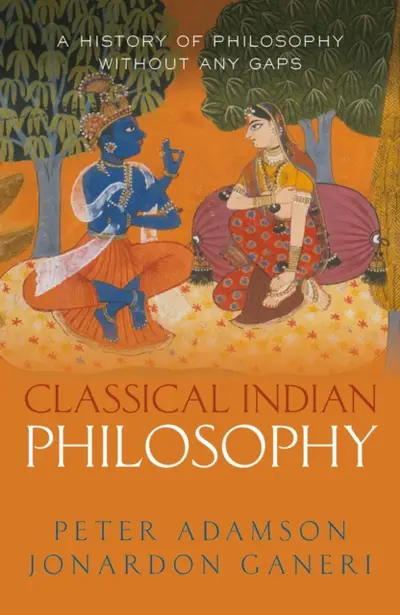
Classical Indian Philosophy
A history of philosophy without any gaps, Volume 5
Price and availability
$12.99
Available in: Andorra, Austria, Australia, Belgium, Bulgaria, Canada, Switzerland, Cyprus, Czechia, Germany, Denmark, Estonia, Spain, Finland, France, United Kingdom, Guernsey, Greece, Croatia, Hungary, Ireland, Isle of Man, Iceland, Italy, Jersey, Japan, Liechtenstein, Lithuania, Luxembourg, Latvia, Monaco, Malta, Netherlands, Norway, Poland, Portugal, Romania, Sweden, Slovenia, Slovakia, San Marino, United States, Vatican City, South Africa
Stores: US, UK, Canada, EU, Australia.
Sign in to buyThe price is re-checked by the server before payment.
For personal use under the eBook licence.
- Format
- EPUB
- DRM
- Not stated by the publisher
- Language
- English
- Publisher
- Oxford University Press
- Published
- 26 March 2020
- ISBN
- 9780192592675
- Subjects
- Indian sub-continent, History of Western philosophy, Oriental & Indian philosophy, Philosophy: metaphysics & ontology, Philosophy: epistemology & theory of knowledge, Philosophy: logic, Philosophy: aesthetics, Philosophy of religion, Buddhism, Hinduism, Jainism, History of ideas, History of ideas, East Asian and Indian philosophy, Philosophy: metaphysics and ontology, Philosophy: epistemology and theory of knowledge, Philosophy: logic, Philosophy: aesthetics, Philosophy of religion, Hinduism, Buddhism, Jainism
About this book
Peter Adamson and Jonardon Ganeri present a lively introduction to one of the world's richest intellectual traditions: the philosophy of classical India. They begin with the earliest extant literature, the Vedas, and the explanatory works that these inspired, known as Upanisads. They also discuss other famous texts of classical Vedic culture, especially the Mahabharata and its most notable section, the Bhagavad-Gita, alongside the rise of Buddhism and Jainism. In this opening section, Adamson and Ganeri emphasize the way that philosophy was practiced as a form of life in search of liberation from suffering. Next, the pair move on to the explosion of philosophical speculation devoted to foundational texts called 'sutras,' discussing such traditions as the logical and epistemological Nyaya school, the monism of Advaita Vedanta, and the spiritual discipline of Yoga. In the final section of the book, they chart further developments within Buddhism, highlighting Nagarjuna's radical critique of 'non-dependent' concepts and the no-self philosophy of mind found in authors like Dignaga, and within Jainism, focusing especially on its 'standpoint' epistemology. Unlike other introductions that cover the main schools and positions in classical Indian philosophy, Adamson and Ganeri's lively guide also pays attention to philosophical themes such as non-violence, political authority, and the status of women, while considering textual traditions typically left out of overviews of Indian thought, like the Carvaka school, Tantra, and aesthetic theory as well. Adamson and Ganeri conclude by focusing on the much-debated question of whether Indian philosophy may have influenced ancient Greek philosophy and, from there, evaluate the impact that this area of philosophy had on later Western thought.
Bibliographic data © Gardners Books Ltd.