EPUB · English
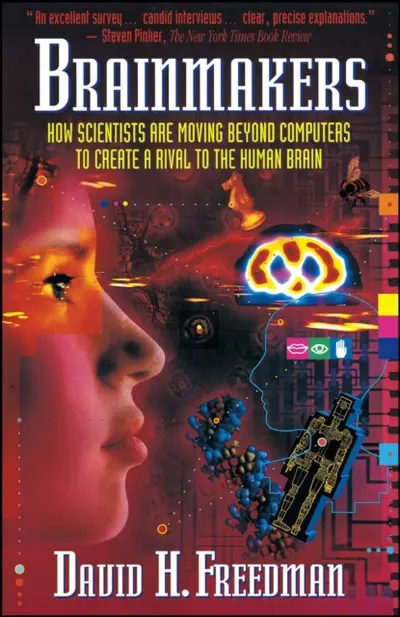
Brainmakers: How Scientists Moving Beyond Computers Create Rival to Humn Brain
Price and availability
$17.99
Available in: Andorra, Austria, Australia, Belgium, Bulgaria, Canada, Switzerland, Cyprus, Czechia, Germany, Denmark, Estonia, Spain, Finland, France, United Kingdom, Guernsey, Greece, Croatia, Hungary, Ireland, Isle of Man, Iceland, Italy, Jersey, Japan, Liechtenstein, Lithuania, Luxembourg, Latvia, Monaco, Malta, Netherlands, Norway, Poland, Portugal, Romania, Sweden, Slovenia, Slovakia, San Marino, United States, Vatican City, South Africa
Stores: US, UK, Canada, EU, Australia.
Sign in to buyThe price is re-checked by the server before payment.
For personal use under the eBook licence.
- Format
- EPUB
- DRM
- Not stated by the publisher
- Language
- English
- Publisher
- Touchstone
- Published
- 15 June 2010
- ISBN
- 9781439142790
- Subjects
- Science: general issues, Science: general issues
About this book
A fascinating tour behind the scenes at laboratories around the world as top researchers race to create revolutionary "e;thinking machines"e; that may one day lead to a new form of intelligence. Join David Freedman as he takes you on a fascinating tour behind the scenes at laboratories around the world as top researchers race to create revolutionary "e;thinking machines"e; that may one day lead to a new form of intelligence. The subject of fantasy and skepticism for centuriesfrom William James's mechanical bride to 2001's Hal to Star Wars' R2D2artificial intelligence has been limited to number-crunching computers that are "e;smart"e; only in highly specific domains like chessuntil now. Brainmakers is an eye-opening, mind-expanding, and mind-blowing journey through laboratories engaged in cutting-edge research into neuroscience and robotics. Inside, you'll discover: MIT's Attila, a 3.6-pound, six-legged robot that learns as it interacts with its surroundings. Japan's efforts to grow brain cells on chips and construct a "e;wiring diagram"e; of the human brain. UCLA's "e;robot farm,"e; where robots will be "e;bred"e; for intelligence. In exciting yet accessible detail, Freedman shows how this research has moved into a new realm that transcends computer science, combining neuroscience, microbiology, evolutionary biology, and zoology. Modeled after natural rather than artificial intelligence, thinking machines may soon develop powers that rivalor exceedthose of the human brain.
Bibliographic data © Gardners Books Ltd.