PDF · English
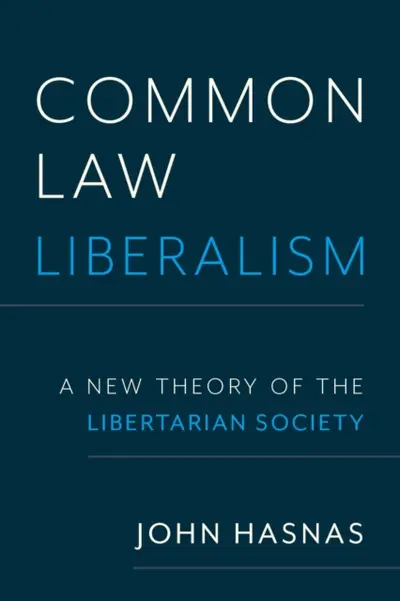
Common Law Liberalism
A New Theory of the Libertarian Society
Price and availability
$66.99
Available in: Andorra, Austria, Australia, Belgium, Bulgaria, Canada, Switzerland, Cyprus, Czechia, Germany, Denmark, Estonia, Spain, Finland, France, United Kingdom, Guernsey, Greece, Croatia, Hungary, Ireland, Isle of Man, Iceland, Italy, Jersey, Japan, Liechtenstein, Lithuania, Luxembourg, Latvia, Monaco, Malta, Netherlands, Norway, Poland, Portugal, Romania, Sweden, Slovenia, Slovakia, San Marino, United States, Vatican City, South Africa
Stores: US, UK, Canada, EU, Australia.
Sign in to buyThe price is re-checked by the server before payment.
For personal use under the eBook licence.
- Format
- DRM
- Not stated by the publisher
- Language
- English
- Publisher
- Oxford University Press
- Published
- 26 July 2024
- ISBN
- 9780197784617
- Subjects
- Ethics & moral philosophy, Social & political philosophy, Jurisprudence & philosophy of law, Common law, Methods, theory and philosophy of law, Systems of law: common law, QDTQ, QDTS
About this book
In conventional political philosophy, law is understood as consciously created rules that are a necessary mechanism for regulating the excesses of the free market. Although coercive in nature, law is seen as a necessary defense against anarchy. But is the situation that simple? In his examination of the purpose and functioning of the legal system, John Hasnas challenges this false dichotomy, presenting a new theory of liberalism that demonstrates that the common law can serve as an effective alternative to traditional politically created legislation. Hasnas argues that there are options beyond the unregulated market or a market regulated by consciously created government law. Instead, he suggests, law can arise through a process of unplanned evolution in which those subject to law are bound, but not by the will of any identifiable human beings. Anglo-American common law, which evolved without a guiding human intelligence, showcases this. Over the centuries of its development, the common law process created the rules of contract, property, tort, and commercial law that define key aspects of liberal society. Common law's decentralized and continually evolving nature renders it resistant to political rent-seeking and responsive to changing economic and social conditions--allowing it to adapt to the needs of those it serves to protect, rather than to the desires of a powerful few. Hasnas suggests that while the enforcement of law may involve coercion, law in and of itself is not destined to be a vehicle for domination. Common Law Liberalism demonstrates that the common law can provide all rules necessary to sustain a peaceful, prosperous, liberal society--without intervention by politically created legislation and the exploitation and oppression it so often engenders.
Bibliographic data © Gardners Books Ltd.