PDF · English
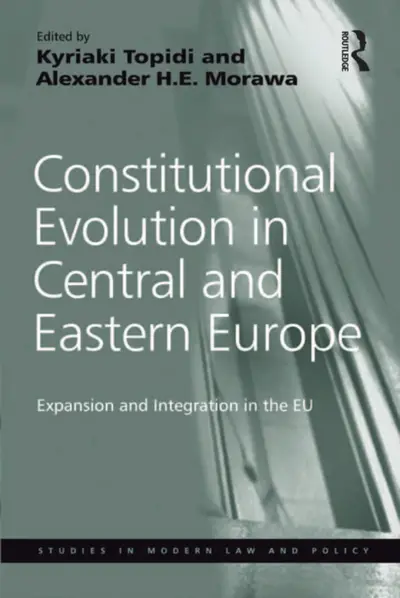
Constitutional Evolution in Central and Eastern Europe
Expansion and Integration in the EU
Price and availability
$78.99
Available in: Andorra, Austria, Australia, Belgium, Bulgaria, Canada, Switzerland, Cyprus, Czechia, Germany, Denmark, Estonia, Spain, Finland, France, United Kingdom, Guernsey, Greece, Croatia, Hungary, Ireland, Isle of Man, Iceland, Italy, Jersey, Japan, Liechtenstein, Lithuania, Luxembourg, Latvia, Monaco, Malta, Netherlands, Norway, Poland, Portugal, Romania, Sweden, Slovenia, Slovakia, San Marino, United States, Vatican City, South Africa
Stores: US, UK, Canada, EU, Australia.
Sign in to buyThe price is re-checked by the server before payment.
For personal use under the eBook licence.
- Format
- DRM
- Not stated by the publisher
- Language
- English
- Publisher
- Taylor & Francis
- Published
- 14 December 2016
- ISBN
- 9781317161714
- Subjects
- Central Europe, Eastern Europe, Jurisprudence & general issues, Law & society, International law, Constitutional & administrative law, Central Europe, Public international law: human rights, Judicial review, Constitution
About this book
This book examines EU enlargement by studying how domestic constitutional evolution in the new member states contributes to European integration. In contrast to the usual top-down analytical pattern, it reverses the paradigm by looking at constitutional developments and dynamics from the bottom-up, studying how domestic constitutional evolution contributes to European integration. The authors analyze constitutional trends from the perspective of 'new Member States' as policy-makers and not strictly as policy-takers. The issue of conditionality is also explored in a discussion of the extent to which pre-2004 and 2007 conditionality has had lasting effects at the level of constitutionalization of different areas and norms and if so, of what kind. The exploration of Europeanization effects in recent Member States substantiates and demonstrates how enlargement has been an important driving-force for the effective export of EU legal rules in this region. The book utilizes a comparative approach to highlight the merits and obstacles created by the growing diversity in the constitutional rules and patterns of the new Member States. It also contains a section that places the CEE constitutionalizing map in a broader comparative European and global context, establishing links with similar transitional regimes in the continent and elsewhere.
Bibliographic data © Gardners Books Ltd.