EPUB · English
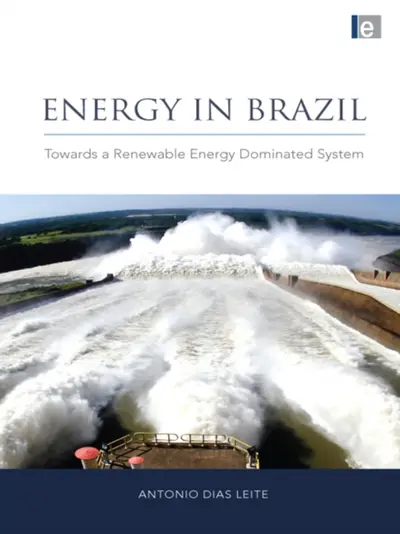
Energy in Brazil
Towards a Renewable Energy Dominated System
Price and availability
$239.99
Available in: Andorra, Austria, Australia, Belgium, Bulgaria, Canada, Switzerland, Cyprus, Czechia, Germany, Denmark, Estonia, Spain, Finland, France, United Kingdom, Guernsey, Greece, Croatia, Hungary, Ireland, Isle of Man, Iceland, Italy, Jersey, Japan, Liechtenstein, Lithuania, Luxembourg, Latvia, Monaco, Malta, Netherlands, Norway, Poland, Portugal, Romania, Sweden, Slovenia, Slovakia, San Marino, United States, Vatican City, South Africa
Stores: US, UK, Canada, EU, Australia.
Sign in to buyThe price is re-checked by the server before payment.
For personal use under the eBook licence.
- Format
- EPUB
- DRM
- Not stated by the publisher
- Language
- English
- Publisher
- Taylor & Francis
- Published
- 25 September 2009
- ISBN
- 9781136574566
- Subjects
- Politics & government, Climate change, Energy efficiency, Alternative & renewable energy sources & technology, Environmental science, engineering & technology, Brazil, Climate change, Alternative and renewable energy sources and technology, Energy, power generation, distribution and storage
About this book
Rapidly developing countries such as China and India are the real main players in the climate debate, with the potential for massive increases in their carbon emissions in coming years. Brazil is often included in their number, yet this country is in fact notable for its exceptionally high reliance on energy from renewable sources - approaching 50%. However, the fact that much of this energy comes from hydropower and biofuels, and recent discoveries of massive oil reserves off of the Brazilian coast, are a recipe for controversy. In this detailed account, Antonio Dias Leite sets out the development of Brazil's energy mix. Beginning with the history of energy provision and use, he then moves on to tackle the various sources in detail: hydropower, biomass and other renewables, as well as fossil fuels and nuclear power. In each case he examines growth, distribution, environmental and socio-economic issues (such as deforestation and displacement of indigenous communities) and potential for future development - highlighting what has worked, and what hasn't. The book ends by examining Brazilian approaches to energy efficiency, and by positioning Brazil in the world context. This is a major contribution to the discussion around climate change mitigation that will be key reading for policymakers and researchers concerned with the future role and impacts of rapidly developing countries.
Bibliographic data © Gardners Books Ltd.