PDF · English
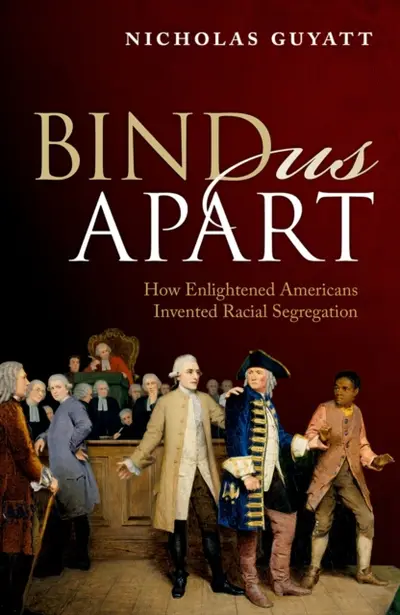
Bind Us Apart
How Enlightened Americans Invented Racial Segregation
Price and availability
$25.99
Available in: Andorra, Austria, Australia, Belgium, Bulgaria, Canada, Switzerland, Cyprus, Czechia, Germany, Denmark, Estonia, Spain, Finland, France, United Kingdom, Guernsey, Greece, Croatia, Hungary, Ireland, Isle of Man, Iceland, Italy, Jersey, Japan, Liechtenstein, Lithuania, Luxembourg, Latvia, Monaco, Malta, Netherlands, Norway, Poland, Portugal, Romania, Sweden, Slovenia, Slovakia, San Marino, United States, Vatican City, South Africa
Stores: US, UK, Canada, EU, Australia.
Sign in to buyThe price is re-checked by the server before payment.
For personal use under the eBook licence.
- Format
- DRM
- Not stated by the publisher
- Language
- English
- Publisher
- OUP Oxford
- Published
- 11 August 2016
- Pages
- 416
- ISBN
- 9780192516619
- Subjects
- c 1700 to c 1800, c 1800 to c 1900, History of the Americas, Modern history to 20th century: c 1700 to c 1900, Social & cultural history, Colonialism & imperialism, Ethnic minorities & multicultural studies, 3ML, 3MN, JBSL1, NH, NHK, NHTB, NHTQ
About this book
The surprising and counterintuitive origins of America's racial crisisWhy did the Founding Fathers fail to include blacks and Indians in their cherished proposition that "e;all men are created equal"e;? The usual answer is racism, but the reality is more complex and unsettling. In Bind Us Apart, historian Nicholas Guyatt argues that, from the Revolution through the Civil War, most white liberals believed in the unity of all human beings. But their philosophy faltered when it came to the practical work of forging a colour-blind society. Unable to convinceothers - and themselves - that racial mixing was viable, white reformers began instead to claim that people of colour could only thrive in separate republics: in Native states in the American West or in the West African colony of Liberia. Herein lie the origins of "e;separate but equal."e; Decades before Reconstruction, America's liberal elite was unable to imagine how people of colour could become citizens of the United States. Throughout the nineteenth century, Native Americans were pushed farther and farther westward, while four million slaves freed after the Civil War found themselves among a white population that had spent decades imagining that they would live somewhere else.
Bibliographic data © Gardners Books Ltd.