PDF · English
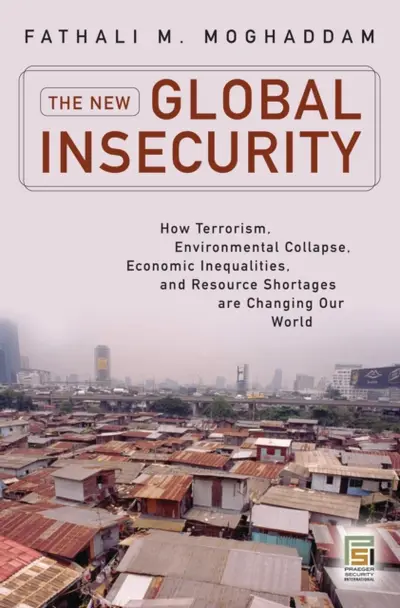
New Global Insecurity
How Terrorism, Environmental Collapse, Economic Inequalities, and Resource Shortages Are Changing Our World
Price and availability
$25.99
Available in: Andorra, Austria, Australia, Belgium, Bulgaria, Canada, Switzerland, Cyprus, Czechia, Germany, Denmark, Estonia, Spain, Finland, France, United Kingdom, Guernsey, Greece, Croatia, Hungary, Ireland, Isle of Man, Iceland, Italy, Jersey, Japan, Liechtenstein, Lithuania, Luxembourg, Latvia, Monaco, Malta, Netherlands, Norway, Poland, Portugal, Romania, Sweden, Slovenia, Slovakia, San Marino, United States, Vatican City, South Africa
Stores: US, UK, Canada, EU, Australia.
Sign in to buyThe price is re-checked by the server before payment.
For personal use under the eBook licence.
- Format
- DRM
- Not stated by the publisher
- Language
- English
- Publisher
- Bloomsbury Publishing (USA)
- Published
- 22 January 2010
- Pages
- 212
- ISBN
- 9780313365089
- Subjects
- Politics & government, International relations, Politics and government, International relations
About this book
A noted conflict expert shows how accelerating globalization is causing dangerous global insecurity that must be met by new security models and policies.The New Global Insecurity: How Terrorism, Environmental Collapse, Economic Inequalities, and Resource Shortages Are Changing Our World explores insecurity arising out of accelerating globalization. In this unique and forward-thinking work, psychologist Fathali M. Moghaddam, director of the Conflict Studies Program at Georgetown University, explains how and why worldwide insecurity is rising and what steps we must take to quell or reverse that insecurity to make the future of the world more peaceful.The book first analyzes the elements and roots of global insecurity, discussing it in relation to terrorism, torture, economic instability, threatened identity, and religious fundamentalism. It then puts forward a new model for understanding security, wherein "e;soft security capital"e; serves as the enabling condition for "e;hard security capital."e; Finally, the current policies for managing diversity, "e;multiculturalism"e; and "e;assimilation"e; are both rejected in favor of an exciting new policy-"e;omniculturalism"e;. Drawing on his years of study and expertise, Moghaddam likewise proposes a new policy for better managing intergroup relations in an insecure age.
Bibliographic data © Gardners Books Ltd.