EPUB · English
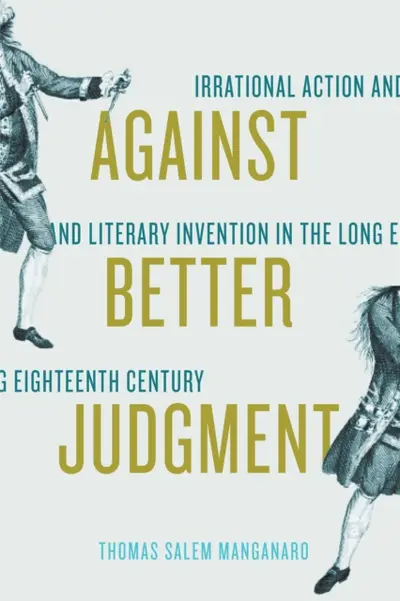
Against Better Judgment
Irrational Action and Literary Invention in the Long Eighteenth Century
Price and availability
$39.99
Available in: Andorra, Austria, Australia, Belgium, Bulgaria, Canada, Switzerland, Cyprus, Czechia, Germany, Denmark, Estonia, Spain, Finland, France, United Kingdom, Guernsey, Greece, Croatia, Hungary, Ireland, Isle of Man, Iceland, Italy, Jersey, Japan, Liechtenstein, Lithuania, Luxembourg, Latvia, Monaco, Malta, Netherlands, Norway, Poland, Portugal, Romania, Sweden, Slovenia, Slovakia, San Marino, United States, Vatican City, South Africa
Stores: US, UK, Canada, EU, Australia.
Sign in to buyThe price is re-checked by the server before payment.
For personal use under the eBook licence.
- Format
- EPUB
- DRM
- Not stated by the publisher
- Language
- English
- Publisher
- University of Virginia Press
- Published
- 6 June 2022
- ISBN
- 9780813947310
- Subjects
- English, Literary studies: c 1800 to c 1900, Modern history to 20th century: c 1700 to c 1900, Philosophy of religion, 2ACB, Literary studies: c 1800 to c 1900, NH, QRAB
About this book
Winner--2022 Walker Cowen Memorial Prize Robinson Crusoe recognizes it is foolish to leave for the open seas; nevertheless, he boards the ship. William Wordsworth of The Prelude sees the immense poetic task ahead of him, but instead of beginning work, he procrastinates by going for a walk. Centering on this sort of intentionally irrational action, originally defined as akrasia by the ancient Greeks and weakness of will in early Christian thought, Against Better Judgment argues that the phenomenon takes on renewed importance in the long eighteenth century. In treating human minds and bodies as systems and machines, Enlightenment philosophers did not account for actions that may be undermotivated, contradictory, or self-betraying. A number of authors, from Daniel Defoe and Samuel Johnson to Jane Austen and John Keats, however, took up the phenomenon in inventive ways. Thomas Manganaro traces how English novelists, essayists, and poets of the period sought to represent akrasia in ways philosophy cannot, leading them to develop techniques and ideas distinctive to literary writing, including new uses of irony, interpretation, and contradiction. In attempting to give shape to the ways people knowingly and freely fail themselves, these authors produced a new linguistic toolkit that distinguishes literature's epistemological advantages when it comes to writing about people.
Bibliographic data © Gardners Books Ltd.